
America’s Most Graduate-Concentrated Cities Have the Weakest Entry-Level Job Markets
The metros that attract the highest concentrations of college graduates are the ones offering the weakest entry-level hiring conditions right now.
Overview
Every spring, hundreds of thousands of ambitious college graduates pack their bags and head to a familiar shortlist of desirable cities: San Francisco, Seattle, Austin, Boston, New York, and Washington, DC.
Drawn by career prestige, industry concentration, lifestyle, and long-standing opportunity narratives, graduates are heavily concentrated in these metro areas.
But new analysis suggests those metros may no longer offer the strongest conditions for launching a career.
An in-depth analysis of graduate concentration versus real-world entry-level hiring conditions across America’s 50 largest metropolitan areas reveals a clear disconnect. The majority of the metros with the highest graduate concentration now show weaker entry-level hiring conditions than less competitive alternatives.
Key Takeaways
- Every one of the ten metros with the highest graduate concentration underperforms on the Graduate Employment Index. This pattern holds under multiple reasonable weightings of the index.
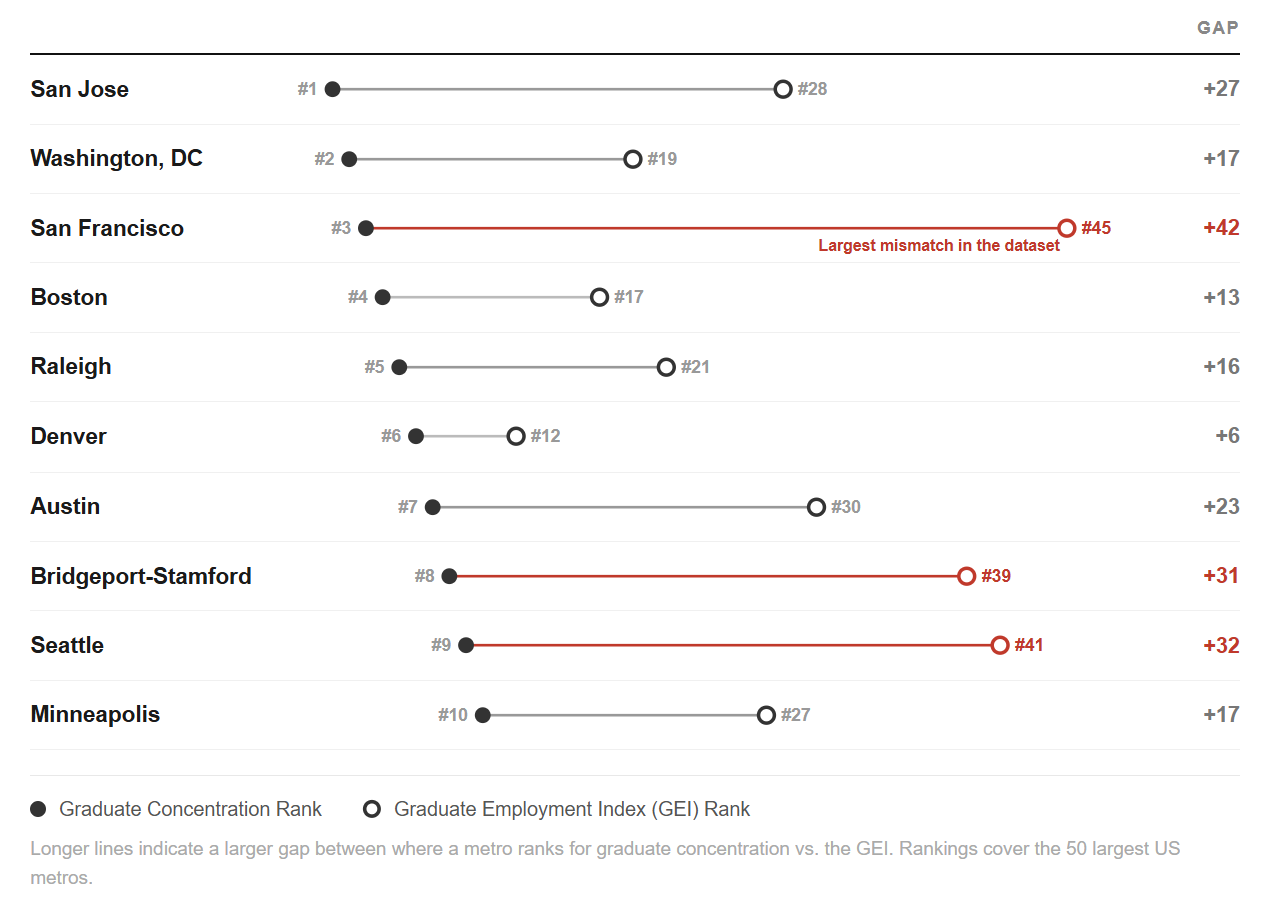
- San Francisco is the sharpest case. It is the 3rd most desirable metro in the country for graduates and ranks 45th for graduate hiring conditions, the single widest gap in the dataset.
- Seattle is close behind, 9th in desirability and 41st for hiring conditions.
- The analysis found virtually no linear relationship between graduate concentration and entry-level hiring strength (correlation of r = 0.009 across all 50 metros).
- The widest gaps cluster in the Bay Area, the Northeast corridor, and the Sunbelt’s biggest graduate magnets.
- Denver is the only highly graduate-concentrated metro that still ranks near the top tier for hiring conditions.
- The strongest entry-level markets are cities graduates overlook: Cincinnati, Grand Rapids, Columbus, Indianapolis, and Cleveland top the country for hiring conditions while sitting well outside the country’s most graduate-concentrated metros.
The Graduate Dream vs. Reality
For more than a decade, a small set of superstar metros became magnets for ambitious young professionals. Graduates moved in waves to cities like San Jose, Washington, DC, San Francisco, Denver, and Raleigh, drawn by innovation, culture, and the promise that careers move faster there.
A city’s graduate concentration (the share of its working-age adults who hold a degree) offers a clear, measurable metric of that pull. Highly educated workers have historically clustered in a relatively small number of metros, and they have piled into the same metros for years. High graduate concentration reflects a combination of economic opportunity, institutional density, prestige, and long-term talent clustering.
So this analysis compares desirability with current entry-level hiring conditions. We compare two measures across the 50 largest U.S. metros.
The first is graduate concentration, measured as the share of working-age adults aged 25 to 64 holding at least a bachelor’s degree, from the American Community Survey.
The second is entry-level hiring conditions for new graduates, captured as our Graduate Employment Index (GEI), a composite of:
- Unemployment among degree-holders
- Real entry-level wage power after cost of living
- The direction hiring has moved over the past year, built on Bureau of Labor Statistics and Bureau of Economic Analysis data.
The relationship between the two is near zero (r = 0.009), suggesting graduate concentration and entry-level hiring conditions are largely unrelated across major metros.
The metros with the highest concentrations of degree-holders are not necessarily the metros offering the strongest entry-level hiring conditions.
The Cities That Attract Graduates and the Cities Hiring Them Have Split Apart
All ten metros with the highest graduate concentration rank lower for entry-level hiring conditions than for concentration itself.
| Metro | Graduate Concentration Rank | Hiring Conditions Rank | Gap |
|---|---|---|---|
| San Francisco | 3 | 45 | +42 |
| Seattle | 9 | 41 | +32 |
| San Jose | 1 | 28 | +27 |
| Austin | 7 | 30 | +23 |
| Boston | 4 | 17 | +13 |
| Denver | 6 | 12 | +6 |
Some of the gaps are small. Denver’s, for instance, is six places, the closest alignment in the top ten. Boston’s is 13. Most, however, are not small at all.
The metros with the highest concentrations of graduates are, in case after case, metros ranking substantially lower for entry-level hiring conditions than their graduate concentration would suggest. It holds on the coasts, in the Sunbelt, and along the Northeast corridor alike.
The Cities Graduates Overlook Are Winning the Entry-Level Economy
Some of the strongest entry-level hiring markets for new graduates are in cities that rank relatively low on graduate desirability.
| Metro | GEI Score | GEI Rank | Desirability Rank | Gap |
|---|---|---|---|---|
| Cincinnati, OH | 82.7 | 1 | 35 | -34 |
| Grand Rapids, MI | 79.9 | 2 | 31 | -29 |
| Columbus, OH | 79.8 | 3 | 26 | -23 |
| Indianapolis, IN | 78.1 | 4 | 29 | -25 |
| Cleveland, OH | 77.5 | 5 | 44 | -39 |
Cincinnati ranks first nationally on the Graduate Employment Index, despite sitting 35th in graduate concentration. Cleveland offers a striking contrast to San Francisco: it ranks 5th best for entry-level hiring conditions but 44th in desirability, a 39-place gap in the opposite direction.
These Midwestern metros provide lower competition for entry-level roles, more affordable living costs, and faster opportunities for meaningful responsibility. While they receive less national attention than coastal hotspots, the data shows they currently rank among the strongest metros for entry-level hiring conditions.
Deep Dive: The Five Cities With the Largest Mismatches
Five metros show gaps of 23 places or more between graduate concentration rank and entry-level hiring rank.
| Metro | Bachelor's share | Desirability Rank | GEI Rank | Gap |
|---|---|---|---|---|
| San Francisco, CA | 56.9% | 3 | 45 | +42 |
| Seattle, WA | 50.7% | 9 | 41 | +32 |
| Bridgeport-Stamford, CT | 53.0% | 8 | 39 | +31 |
| San Jose, CA | 60.1% | 1 | 28 | +27 |
| Austin, TX | 53.9% | 7 | 30 | +23 |
San Francisco stands out as the clearest example. Nearly 57% of its working-age adults hold a degree, making it the 3rd most graduate-desired metro in the country. For actually hiring a new graduate, it ranks 45th of 50, the bottom six.
Seattle is the same story with a 32-place gap. It is the 9th most desirable metro for graduates and the 41st best at hiring them, deep in the bottom fifth.
Bridgeport-Stamford sits inside the wealthy New York commuter belt, 8th for desirability and 39th for hiring. The potential there is tangible, yet entry-level access appears substantially weaker.
San Jose has the highest graduate concentration in the dataset at 60.1%, yet ranks just 28th for entry-level hiring conditions. The metro with the country’s highest concentration of degree-holders currently sits mid-pack for launching a career.
Austin shows one of the sharpest gaps among major Sunbelt metros. The 7th most desirable metro for graduates, 30th for hiring them, the largest gap of any city in the South.
Denver Is the Exception in the Top Ten
Of the ten metros with the highest graduate concentration, only one still delivers a strong entry-level market: Denver.
Denver is the 6th most graduate-desired metro in the country and the 12th best at hiring them, a gap of just six places. It is the only city in the top ten where graduate concentration and hiring conditions remain more closely aligned, helped by solid real wages at the entry level and stable hiring.
| Metro | Desirability Rank | GEI Rank | Gap |
|---|---|---|---|
| Denver, CO | 6 | 12 | +6 |
| Boston, MA | 4 | 17 | +13 |
| Raleigh, NC | 5 | 21 | +16 |
| Washington, DC | 2 | 19 | +17 |
| Minneapolis, MN | 10 | 27 | +17 |
Boston, Raleigh, Washington, DC, and Minneapolis form the next tier, gaps of 13 to 17 places. Every one of the remaining five top-ten metros sits on the largest-mismatch list above. One city in ten is the exception. The other nine show noticeable gaps.
The Bay Area Holds the Country’s Largest Gaps
The two California metros that attract the most college graduates also show some of the weakest entry-level hiring conditions in the country.
San Jose leads the nation in graduate concentration at 60.1% but ranks 28th on the Graduate Employment Index. San Francisco, with a 56.9% bachelor’s degree share among working-age adults, ranks 3rd in desirability yet 45th for entry-level hiring, which is the largest gap in the 50-metro analysis.
Together, the two metros sit outside the top 25 for graduate hiring conditions.
The Northeast Corridor’s Hiring Conditions Lagged Its Graduate Concentration
Three of the ten most desired metros for graduates lie along the Northeast corridor. None rank in the top ten for entry-level hiring conditions.
| Metro | Desirability Rank | Bachelor's share | GEI Rank | Gap |
|---|---|---|---|---|
| Washington, DC | 2 | 57.4% | 19 | +17 |
| Boston, MA | 4 | 56.8% | 17 | +13 |
| Bridgeport-Stamford, CT | 8 | 53.0% | 39 | +31 |
Boston performs best among the three at 17th on the GEI, followed by Washington at 19th. Bridgeport-Stamford lags at 39th.
The corridor’s concentration of elite universities, federal agencies, finance, and biotech has historically concentrated large numbers of degree-holders. However, current entry-level hiring conditions rank substantially lower than the corridor’s graduate concentration would suggest.
Austin and the Sunbelt: Hiring Conditions Failed to Keep Pace
The Sunbelt’s major graduate magnets followed a similar pattern.
Metro Desirability Rank Bachelor's share GEI Rank Gap
Austin, TX 7 53.9% 30 +23
Raleigh, NC 5 54.8% 21 +16
Austin now ranks 7th in graduate desirability but 30th for entry-level hiring conditions. This is the widest gap among major Southern metros. Raleigh ranks 5th in desirability and 21st on the GEI.
Both cities experienced strong inflows of young talent over the past decade. Current data shows weaker hiring conditions relative to their level of graduate concentration.
The Cities With the Largest Negative Gaps
A second set of metros sits on the opposite side of the divide. Each ranks at least 22 places higher for entry-level hiring conditions than for graduate concentration.
| Metro | Desirability Rank | Bachelor's share | GEI Rank | Gap |
|---|---|---|---|---|
| Cleveland, OH | 44 | 37.30% | 5 | −39 |
| Louisville, KY-IN | 46 | 35.60% | 11 | −35 |
| Cincinnati, OH-KY-IN | 35 | 39.90% | 1 | −34 |
| Grand Rapids, MI | 31 | 40.80% | 2 | −29 |
| Memphis, TN-MS-AR | 47 | 33.70% | 18 | −29 |
| Providence, RI-MA | 39 | 38.40% | 13 | −26 |
| Detroit, MI | 40 | 38.10% | 14 | −26 |
| Indianapolis, IN | 29 | 41.60% | 4 | −25 |
| Columbus, OH | 26 | 42.60% | 3 | −23 |
| Buffalo, NY | 28 | 41.80% | 6 | −22 |
Cleveland leads the list at −39 places, ranking 5th for entry-level hiring conditions and 44th for graduate concentration. The gap is the largest negative mismatch in the dataset.
Louisville is second at −35 places. It ranks 11th nationally on the Graduate Employment Index, ahead of Denver, Boston, Washington DC, and Austin, while sitting 46th of 50 for graduate concentration.
Cincinnati ranks first nationally on the GEI but 35th for graduate concentration, a −34 gap. The Cincinnati MSA is defined federally as Cincinnati, OH-KY-IN, including seven Northern Kentucky counties.
Six of the ten metros are in the Midwest: Cleveland, Cincinnati, Grand Rapids, Indianapolis, Columbus, and Detroit. Louisville and Memphis are in the South. Providence and Buffalo sit in the Northeast outside the corridor cities.
Eight of the ten rank in the top 15 nationally on the GEI. None ranks in the top 25 for graduate concentration.
Why This Matters for the Class of 2026
Despite conventional advice to move to superstar cities, this data suggests many graduates may find stronger early-career opportunities elsewhere.
Some of the strongest early-career hiring conditions are emerging outside the country’s most graduate-concentrated metros.
The findings suggest graduates may benefit from widening their geographic search beyond the traditional graduate magnet metros.
For employers and recruiters, the same finding points to talent that gets missed because the conventional advice funnels every ambitious graduate into the same five or six metros. The findings suggest graduates may benefit from evaluating hiring conditions as closely as they evaluate a city’s reputation or prestige.
Expert Perspective
Joel Koncinsky, Public Relations and Social Media Manager, Vector Marketing
Joel works directly with early-career talent and has spent his career watching how graduates decide where to start. We asked him what the findings mean for someone choosing a city after college.
Some of the strongest opportunities for young professionals today may exist in cities that students have historically overlooked. Lower costs, faster-growing industries, and less saturated labor markets can create better conditions for building experience and momentum early in a career. Graduates may need to stop asking, ‘What’s the best city?’ and start asking, ‘Where can I actually build leverage?’
Methodology
This study analyzed graduate desirability and entry-level hiring conditions across the 50 largest U.S. Metropolitan Statistical Areas, ranked by 2024 American Community Survey population aged 25 to 64. All 50 metros had complete data across all four federal sources used. Full dataset is available here.
Graduate desirability. This is measured as graduate concentration, the share of the metro population aged 25 to 64 holding a bachelor’s degree or higher, from ACS 2024 one-year estimates, Table B23006. Graduate concentration is used as the proxy for long-term graduate attraction and retention because highly educated workers have historically clustered in a relatively small number of economically and institutionally dense metros.
The Graduate Employment Index (GEI). This is a weighted composite of three metrics, each normalized to a zero-to-100 scale across the 50-metro sample: bachelor’s-degree unemployment rate (50% weight), real entry-level wage power, calculated as the OEWS 25th-percentile annual wage divided by the BEA Regional Price Parity index and multiplied by 100 (30% weight), and year-over-year unemployment momentum, the change in metro unemployment rate between January 2025 and January 2026 (20% weight).
Why unemployment leads the index. Bachelor’s-degree unemployment is the most direct available measure of whether a metro is actually hiring degree-holders into work right now. Wage power and hiring momentum are supporting components because they describe the quality and direction of that market rather than whether the door is open at all.
Sensitivity. The pattern among the top ten metros holds under alternative weightings. Every one of the ten most graduate-desired metros continued to underperform on hiring conditions under equal-thirds weighting, under an unemployment-led weighting, and under the baseline. The pattern, and the near-zero correlation, hold across any weighting that keeps the index centered on hiring conditions. They weaken only if the index is re-specified to be majority-driven by wage levels, which would measure graduate earning power rather than hiring access, a different question from the one this study asks.
Limitations. Graduate concentration is an indirect proxy for metro desirability and may also reflect long-term industry composition, institutional density, and historical migration patterns rather than current graduate preferences alone. The Graduate Employment Index measures present hiring conditions rather than long-term career outcomes, and results may shift over time as labor-market conditions change.
Sources: ACS 2024 one-year estimates, Table B23006; BLS Occupational Employment and Wage Statistics, May 2024; BEA Regional Price Parities, 2024; BLS Local Area Unemployment Statistics, January 2025 to January 2026; Brookings Institution graduate migration analysis.
About The Vector Impact
The Vector Impact connects ambitious young people with meaningful sales and leadership opportunities through Vector Marketing and Cutco. We believe in the value of real-world experience and publish transparent, data-backed research to help the next generation make smarter career and location decisions.
Fair Use Statement
This content may be used for non-commercial purposes with attribution and a link back to The Vector Impact.
Related Reading
The 21 Best Commencement Speeches of All Time
How To Take Responsibility for Your Actions (and Grow in the Process)
What Should I Do With My Life? These 10 Questions Will Tell You
The 9-to-5 Office Job Is Dead. Here Are All the Different Ways To Work in 2026.