
First came the Great Resignation. Now many Americans appear to be asking a harder question, not whether to leave their jobs, but whether those jobs mean anything at all.
Searches for “meaningful work” have climbed 615% over the past decade to record highs, while searches for “lack of purpose” have hit all-time highs of their own. Over the same period, US employee engagement has fallen to its lowest level in ten years.
Call it the great reassessment of work. After years of upheaval, from pandemic-era career changes to widespread burnout and mounting anxiety about AI reshaping jobs, the way Americans think about what work is for appears to be shifting. A decade of Google search data, analyzed by The Vector Impact, tells a single story from two directions: rising interest in meaning, alongside a rising sense of its absence.
The numbers behind the shift
- “Meaningful work” searches hit a record high, rising from 13 to 93 on Google’s 0–100 index since 2016, more than a sevenfold increase.
- “Lack of purpose” searches reached an all-time high, climbing from 8 to a peak of 100 over the same period.
- US employee engagement fell to a decade low, from a 2020 peak of 36 percent to 31 percent in 2025, according to Gallup.
- Both search trends accelerated sharply after 2022 and kept climbing through early 2026.
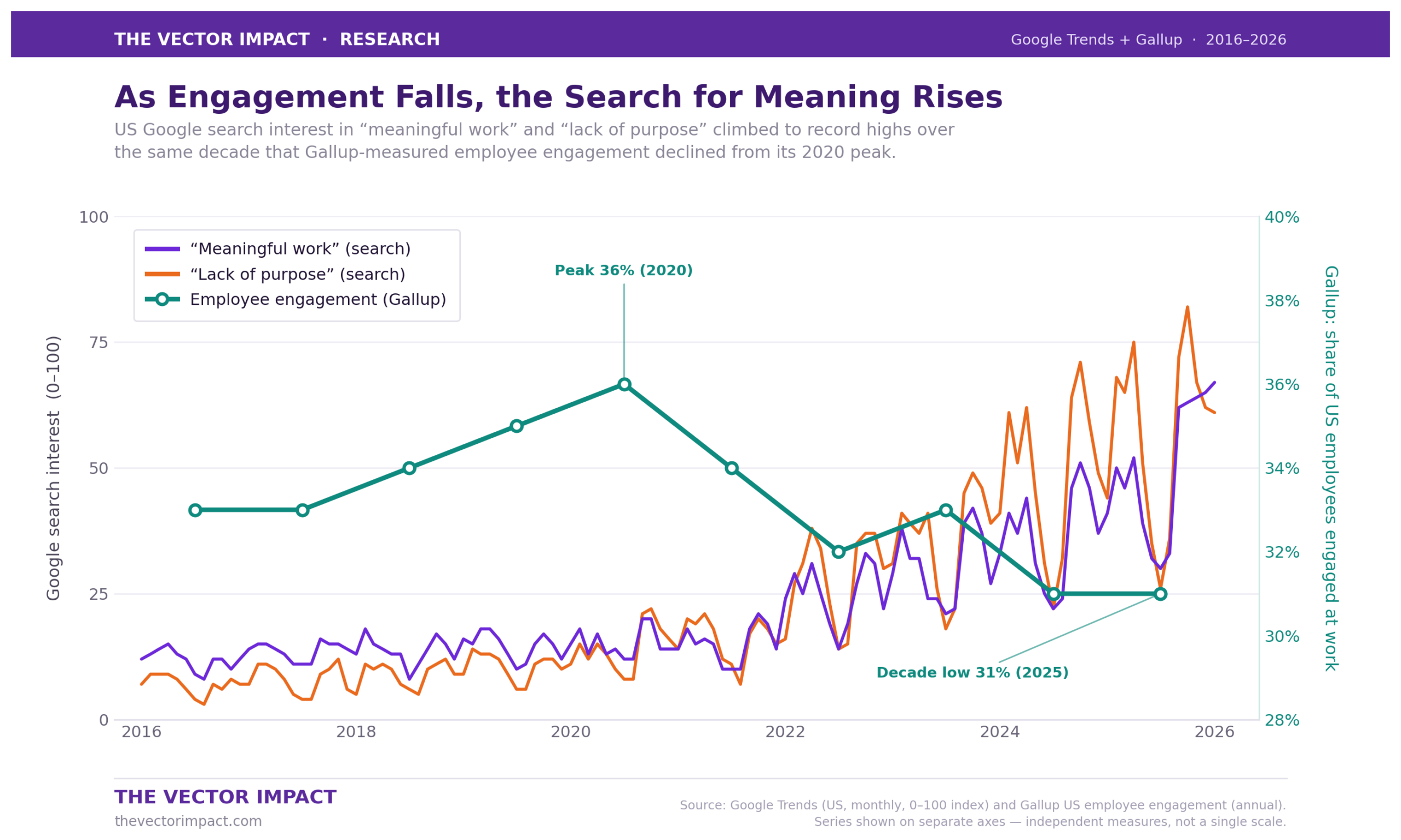
Figure 1: A ten-year view of US Google search interest in “meaningful work” and “lack of purpose,” shown alongside Gallup US employee engagement. Source: Google Trends, US search data, 2016–2026; Gallup Employee Engagement Report.
A search for something work isn’t providing
The two trends point the same way from opposite ends. One measures what people are reaching for; the other measures what they feel is missing. Both rose to record highs at once, and both climbed fastest after 2022, the years that also brought return-to-office battles, waves of layoffs, and the first real anxiety about AI at work. As the searches rose, the share of US workers who feel engaged at their jobs fell to its lowest point in a decade.
“Meaningful work” rose from an index score of 13 in 2016 to a record 93 in 2026, while “lack of purpose” climbed from 8 to a peak of 100. Gallup’s engagement figure moved the other way, slipping from 36 percent in 2020 to 31 percent in 2025. The lines cross in early 2026: peak interest in purpose, record-low engagement, in the same few months.
“After years of conversations focused on flexibility, remote work and compensation, Americans increasingly appear to be asking a different question: whether their work feels meaningful at all,” says Joel Koncinsky, Public Relations and Social Media Manager at Vector Marketing.
The shift is not confined to one generation. Younger workers have long been associated with putting purpose ahead of pay, but the search data suggests that expectation is spreading, a once-generational attitude becoming a broadly American one.
As engagement falls and searches for purpose keep climbing, the data points to a quiet change in what Americans want from work. Increasingly, many are no longer asking how to make a living, but whether their work means anything at all.
About the data: figures are from monthly US Google Trends data (2016–2026) for “meaningful work” and “lack of purpose,” indexed 0–100 to reflect relative search interest, and from Gallup’s annual US employee engagement survey. The two are independent measures shown side by side. Sources: Google Trends; Gallup. This content may be used for non-commercial purposes with attribution and a link back to The Vector Impact.
Related Reading
What Should I Do With My Life? These 10 Questions Will Tell You
Quit Saying ‘I Don’t Know What Career I Want.’ Do This Instead.
Want a Meaningful Career? 8 Signs That Have Nothing To Do With Money or Status
How To Take Responsibility for Your Actions (and Grow in the Process)
The 9-to-5 Office Job Is Dead. Here Are All the Different Ways To Work in 2026.