You walk into a meeting, say all the right things, and somehow still leave feeling like it didn’t land.
Or you’re in a conversation with a coworker and something feels off, even though nothing technically went wrong.
That gap between what’s said and what’s actually communicated? That’s nonverbal communication doing its job. Or failing to.
We often think about communication only in terms of the words we speak, but that’s an incomplete picture. Researcher Ray Birdwhistell estimated that nonverbal communication accounts for at least 60 to 70% (!) of what humans convey to each other.
That makes all of our nonverbal habits pretty critical for both the personal and the professional.
Your words are just the script. Everything else—your posture, your expression, your silence—is doing just as much (if not more) of the heavy lifting when you communicate.
I’ll break down the 6 main types of nonverbal communication (plus one lens for reading them all), what they actually look like in the workplace, and how to use them effectively.
Learn how to talk to anyone
Gain real confidence, build your resume, and get paid.
1. Facial expressions: The channel you can’t turn off

Facial expressions are the most universally recognized type of nonverbal communication, and the hardest to fake convincingly. A genuine smile (the kind that reaches your eyes) lands differently than a polite one. Micro-expressions (brief and involuntary flashes of emotion) often betray feelings before you’ve decided to show them.
In the workplace, this matters more than people like to admit. If someone on your team gives you a tight-lipped smile when you share your idea, they may not be as enthusiastic as they sound. And if you’re the one suppressing a grimace during feedback, people notice.
A review by Carmichael and Mizrahi (2023), covered by the Chronicle of Evidence-Based Mentoring, found that facial expressions are one of the primary channels through which we signal understanding and care in relationships. Your face is constantly communicating your level of investment in the people around you.
Workplace Example: I gave my sales pitch to a customer and got buy-in … or so I thought. He nodded along and gave me a “sounds good.” But I caught a flicker of tension under his eyes when pricing came up, gone almost as fast as it appeared. I confirmed my intuition by asking a few follow-up questions and listening to his hesitations. I was able to suggest a lower-cost product that still met the customer’s needs and better fit into his budget.
2. Body language and kinesics: What your posture is actually saying

Kinesics is the study of body movement as communication. Gestures, posture, eye contact, and physical orientation all fit under this label. It’s what most people vaguely refer to when they say “body language,” and it’s massive.
A few examples that show up constantly at work:
- Leaning in while someone talks signals engagement. Leaning back can signal discomfort or disinterest, even if you’re just tired.
- Open vs. closed posture; arms at your sides or on the table vs. crossed over your chest changes how approachable you appear.
- Eye contact is a big one. Too little reads as evasive; too much becomes a stare-down. The sweet spot communicates confidence and respect simultaneously.
- Mirroring, unconsciously matching someone’s posture or gestures, is a natural signal of rapport. If you’re not seeing any mirroring in a conversation, that’s worth noting.
A 2024 paper in the International Journal of Innovative Research found that nonverbal cues like these often convey more meaning than the words being spoken, influencing how people perceive both individuals and the quality of their interactions. Worth sitting with, especially if you’re in a role where relationships are the product.
Workplace Example: I sat down with a new hire who kept insisting she was “fine” with the account she’d been assigned, but her arms stayed crossed the whole time and she kept angling her chair slightly away from me. Since I knew something was up, I asked her directly what was going on. That curiosity and care opened up the real conversation. She felt overloaded and hadn’t wanted to say so, which never would have surfaced if I’d taken “fine” at face value.
Related: 4 Signs That Reveal a Person’s True Character (If You’re Paying Attention)
3. Proxemics: The unspoken rules of personal space

Proxemics is all about physical distance. Anthropologist Edward Hall identified four distance zones: intimate, personal, social, and public. Most professional interactions happen in the social zone (roughly 4 to 12 feet), and violating those norms, even slightly, can create discomfort.
In any professional setting (in open offices, on sales calls, at networking events), the distance you choose sends a signal about how much authority you’re claiming and how comfortable you are. Standing too far back can read as uncertain, but getting too close can feel pushy. When you get proxemics right, people naturally feel at ease around you.
Proxemics: At a trade show, I noticed a rep standing directly in front of our table display, closing off the space visitors needed to actually approach and look at the product. People were walking past without stopping. I asked him to move to the other side of the table instead, opening that space back up, and foot traffic at the booth picked up almost immediately.
4. Paralanguage: It’s more than the words you say
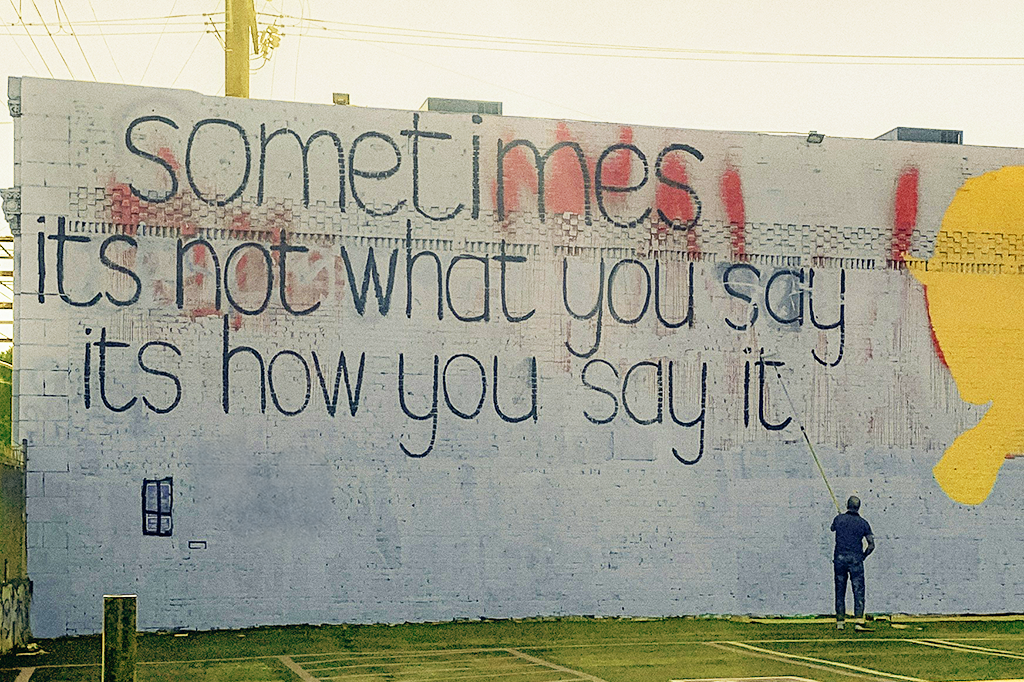
Paralanguage covers the vocal elements that accompany words: tone, pitch, pace, volume, and filler sounds like “um” or “uh.” It’s the difference between “Sure, that sounds great” said warmly and “Sure, that sounds great” said flatly. Same words, entirely different message.
In the workplace, paralanguage is often where people give themselves away. Speaking too fast signals nervousness. Speaking too slowly can lose people. A rising inflection at the end of statements (uptalk) can undermine authority, even if the content is strong.
This connects directly to written communication, too. Paralanguage technically lives in the voice, but its absence in text is exactly why tone is so easy to misread in emails and Slack messages.
Workplace Example: You receive a customer call at an inconvenient time. You should have let it go to voicemail, because you’re rushing to another meeting, but you answer anyway. You’re polite, but short, and the customer feels put off. Even though you technically responded to their questions, your tone didn’t leave a great impression. The next day you leave an apologetic voicemail (with your full attention on the customer), mention a few things they brought up, and suggest getting another call on the calendar as soon as they’re available.
Related:

5. Haptics: When touch communicates

Haptics is the study of touch as communication. In professional contexts, this is mostly handshakes, the occasional pat on the shoulder, or a high-five after a win. Touch conveys warmth, trust, and status, but it’s also the most context-sensitive of all nonverbal channels. What feels like camaraderie in one workplace culture can feel intrusive in another.
The Carmichael and Mizrahi review noted that touch is one of the channels humans use to signal care and responsiveness, right alongside facial expression and vocal tone. In sales, mentorship, and team dynamics, appropriate touch (even something as simple as a firm handshake) meaningfully affects how connected people feel to you.
Workplace Example: Closing a deal with a longtime client, I shook their hand firmly and held eye contact as we wrapped up, which reinforced the rapport we’d built over the meeting rather than leaving the agreement as words alone.
6. Appearance and artifacts: Yes, this counts!

Your clothing, grooming, and even the objects you carry communicate before you open your mouth. This is sometimes called “artifact” communication—the deliberate or unconscious use of objects and appearance to convey identity, professionalism, or affiliation.
A 70-year meta-analysis found professional appearance to be the most powerful nonverbal predictor of interview success. That’s not a cue to dress like someone you’re not. It’s a reminder that how you show up visually shapes the frame through which everything else you do gets interpreted.
Workplace Example: A speaker walked into our conference session in wrinkled clothes, carrying a disheveled and unorganized notebook, and I’d already formed an impression before he’d said a word. It was hard to get past, even though the content was solid. In the next session, the presenter showed up in pressed clothing, clearly put together, and the shift in credibility was obvious. Taking your appearance seriously is a quick win in any professional context.
Encouraging vs. discouraging nonverbal cues
As you’ve likely gathered from the above list, not all nonverbal signals are neutral.
A 2024 study published in “Frontiers in Psychology” developed and validated the Nonverbal Communication Questionnaire (NVCQ), which categorizes nonverbal cues into encouraging (nodding, open posture, warm eye contact) and discouraging (turning away, frowning, checking your phone) types.
This is a useful lens for anyone in a people-focused role. You may not realize you’re sending discouraging signals, but the people on the receiving end feel them clearly. If you’re leading a team or trying to build rapport in sales, auditing your own nonverbal habits is one of the highest-leverage things you can do.
Related: The Real Reason Customers Keep Coming Back
The hardest part: You’re sending signals even when you’re not trying
You’re always communicating (whether you mean to or not)
Nonverbal communication is constant. Being self-aware is the best way to be proactive, since you can’t opt out.
Because silence is a signal, stillness is a signal, and looking at your phone when someone walks into the room is a signal.
You don’t have to be perfect, but making a conscious effort will steer your nonverbal communication to reflect your actual intentions (instead of accidentally contradicting them). That’s what high social intelligence actually looks like in practice.
Understanding these signals helps in every area of life—friendships, first dates, family dynamics. But the workplace is where it has the most direct, measurable impact on how your career unfolds.
Related:


Want to practice your nonverbal communication skills, gain confidence, and get paid? Request an interview.