
Tariq Sikander started 2025 as the number one district in the company in every category.
Then he spent the year defending that spot.
Along the way, he got hit with a low-attendance phone jam and a September that produced a third of the previous year’s sales. Even before the year began, he says there was a stretch where he felt like a solopreneur.
You’d expect a story like that to be about motivation, or about a manager who simply wanted it more. But when Tariq talks about how hard his team worked, he keeps coming back to something less flashy:
Programs, planning, and people.
Below, I’ll break down Tariq’s philosophy and systems, and what any rep or new manager can borrow from them.
Excerpts from this article were originally recorded on the “No Base Pay” podcast.
1. Build the plan around people, not pressure
Tariq’s first year as a district manager was, in his words, “average.”
His first summer as a district manager grew just $10,000 over what his branch had done. It was growth, but not exciting. The turning point was a winter break program he rebuilt from scratch.
Setting aside much of what the team had been doing, he focused on the basics and on his people.
He asked who he could lock arms with and what they wanted to create, and worked backward from there. Then he picked the two things he knew worked (a social media program and team builder), and committed to them.
Fast forward to the following summer.
Tariq sat in the back of a team event, fixated on the fact that he wasn’t number one that week.
He filled three pages of his journal with one line: “It’s not about me.”
He decided to reset by looking at the people who were actually in the room.
If he worked with each of them individually, what could they create?
When he took that approach, he said his team “thought bigger than me.”

Tariq after winning the Silver Cup in the Rising Star category, standing next to his original manager, Sebastian Mysliwiec
2. Put every rep on the whiteboard
About 19% of the reps who launched in Tariq’s office sold over $6,000. In the fast start, his reps averaged just under five orders each, compared with around two company-wide.
His explanation isn’t talent. It’s a weekly ritual.
Every week, Tariq and his assistant managers write out every person on the team, sorted by where they are: first weekend, ending their fast start, Monday-to-Monday group, key staff, and so on.
For each name, they ask one question: If we’re intentional with this person, what could they sell this week?
The totals ended up way bigger than the business plan.
When I’m really intentional with every representative, they are capable of so much more than if I was just hands off.
It starts with belief. “Do I believe that everyone I launched can sell?” Tariq asks.
If you’re a manager and the answer is “no,” he says, hand that person to an assistant manager who does.

Tariq’s first time speaking at Vector’s annual Strategic Leadership Conference (SLC) in San Diego, 2025
3. Make learning part of the calendar
Alongside the weekly whiteboard, Tariq builds structure around events—team meetings, key staff, and division meetings and conferences. He’s proud of his office’s attendance because he’s built a culture that prioritizes learning.
Tariq tells his reps that coaching in most industries is expensive. He runs team meetings because he wants his reps to do better and earn more, which helps the whole team succeed.
Showing up is how skills get built, and a team that learns together tends to grow together.
4. When the plan breaks, adapt fast
Before a push period, Tariq’s team scheduled what they call “the mother of all phone jams,” a 12-hour Sunday session. Attendance was rough. He’d had about $40,000 in sales riding on it, and a couple of top reps were getting cold feet.
He admits he spent part of that day feeling sorry for himself.
Then he called his division manager, who reminded him that the push hadn’t even started yet and his team was watching how their leader showed up.
Tariq moved the second half of the phone jam to the Oakbrook office. The energy changed. One of his assistant managers sold $16,000 in the first week of the push, more than his entire previous career total of $15,000.
September was a different kind of problem.
His office did about a third of the prior year’s sales while booking roughly three times as much “fire number,” the effort that normally leads to results.
His reps were putting in more work and getting less back.
Rather than grind through it, he sidelined the plan and launched a social media recruiting assistant program mid-campaign.
October and November came in at triple the prior year, and the team hit President’s Banquet before winter break.
His takeaway:
You’re going to put in a lot of time and effort for things that are not going to pan out. That’s how a business works … it’s how fast can I adapt?
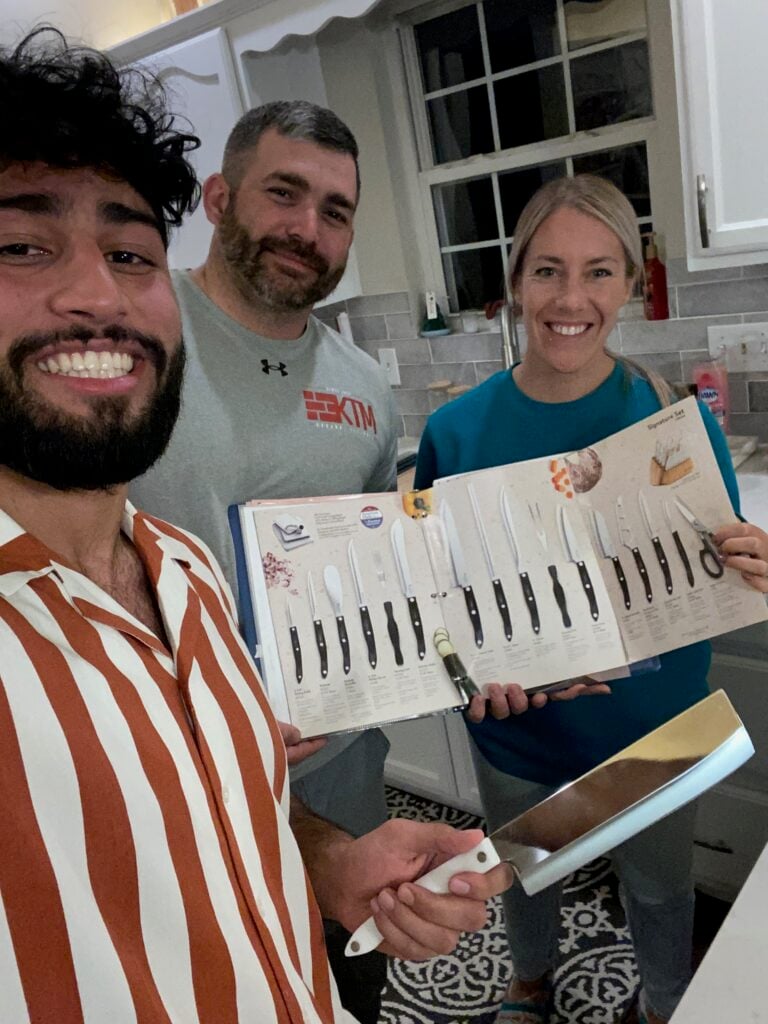
Tariq poses with customers for a selfie.
5. Don’t let the leader’s mood run the business
Tariq’s biggest goal for this year isn’t another Silver Cup. It’s to lean into systems even more.
I want to help systemize our business so it’s not a business that’s driven by how the leader is doing emotionally. It’s a lot more about what are the consistent programs that we have in place.
When his world was at its most difficult, he made a decision to keep going. Making calls, going to demos, and proving to himself that he could perform because he chose to.
That kind of consistency created the habits that became part of how he sees himself.
His advice to new managers follows the same logic:
- Follow a program that works. Memorize, internalize, personalize, just like a rep does with a script. “Don’t try to reinvent the wheel.”
- Avoid being a solopreneur. Find partners, both on your team and elsewhere in your category.
- Don’t be a robot. This job is personal, so feel what you feel. Then pour into what makes you unique.
Systems don’t replace personality and building strong relationships, but they do provide a solid foundation.
Related:


Hard work is just the beginning
The hard work of Tariq’s team was amplified thanks to a weekly planning ritual, a consistent training program, a calendar full of learning, a willingness to change course quickly, and his belief in his team.
You don’t need to run an office to use any of this.
Pick one thing you’re working on, write down what you’d do if you were fully intentional about it, and build a routine around it.
And on the days you don’t feel motivated? Let the system do the work.
.
.
➡️ Ready to give sales a try? Request an interview.
To hear Tariq break all of this down in his own words, listen to his full episode on the No Base Pay Podcast.
Editor’s note: Tariq’s story reflects his own experience and should not be viewed as representative of every Vector career. Like any performance-based profession, individual results vary based on factors including time invested, skill development, goals, and personal effort.