When I was a sophomore in high school, I often found myself worrying about college. Specifically, I was sure that I was going to be stuck in a dorm room with someone who was a terrible roommate.
I voiced this anxiety to my therapist, and that was the first time I heard someone use the phrase “fortune telling” to describe this behavior.
It took some time, but soon I began to recognize a pattern. I would convince myself that I knew exactly how the future was going to unfold, and then I’d work myself into an anxious panic waiting for it all to play out.
Fortune telling is a habit we can fall into when we’re trying to control a situation, but more often than not, it has the opposite effect. Instead of helping us plan for the future, this cognitive distortion actually ends up holding you back.
This article is part of our series on thinking traps. Be sure to check out that article for more advice on overcoming cognitive distortions.
What is the fortune telling cognitive distortion?
Fortune telling is a cognitive distortion where you convince yourself that you already know how the future is going to play out.
The phrase comes from the idea of a classic carnival fortune teller, one who might use a crystal ball or tarot cards to predict the future.
In terms of cognitive behavior, fortune telling is not the same as worrying. Worry is usually about uncertainty—we worry when we don’t have the answers. Fortune telling skips past uncertainty entirely and lands on a conclusion: This is what’s going to happen. Your brain presents it as fact, not an unknown.
Fortune telling can show up in all walks of life. You go into a job interview already knowing you won’t get the offer. You show up to a first date having already decided it won’t go anywhere. You register for a class and spend the whole semester convinced you’re going to fail it—and so you might.
That last part is what makes fortune telling especially tricky. When you’re certain something bad is coming, you behave accordingly. You don’t prepare as hard. You pull back or disengage. And then the thing you predicted comes true. Your fortune-telling prophecy became a self-fulfilling prophecy, all the while reinforcing your subconscious belief that you can and should predict negative outcomes.
It’s dizzying to think about how circular fortune telling behavior is. It’s also easy to confuse it with another thinking trap on our list of cognitive distortions.
Fortune telling vs. catastrophizing
Fortune telling and catastrophizing are close cousins, and they often show up together. But they’re not the same thing.
Catastrophizing is about magnitude—your brain takes a situation and imagines the worst possible version of it. A headache becomes a brain tumor. A curt email from your boss means you’re getting fired. The spiral can go on indefinitely, building disaster on top of disaster.
Fortune telling is very similar, but it’s not always about jumping to the most negative conclusion. Fortune telling can also cause you to have unrealistically high expectations. You are certain you will nail that presentation, or make new friends with ease, or land that promotion—and then when you don’t, you are more disappointed than you would have been if you hadn’t convinced yourself you knew the outcome.
➡️ Learn more about catastrophizing
Why do we act as fortune tellers?
There’s nothing wrong with day dreaming, or preparing for a certain situation, be it a job interview or a test or a social event. Fortune telling as a thinking trap begins when you make assumptions about how something will go.
For some people, it’s very easy for these everyday thoughts and anticipations to turn into problematic fortune telling. There are a several reasons this might be the case.
It’s a form of control
Fortune telling is, at its core, a control mechanism. When we can’t control what happens next, predicting it feels like the next best thing. If you already know the outcome, you can prepare for it—or at least that’s what your brain tells you.
We’re wired for pattern recognition
Fortune telling goes back to how we’re wired. Pattern recognition is one of our most fundamental survival tools. Our ancestors learned to read signs in their environment—the behavior of animals, changes in weather, shifts in social dynamics—and use those patterns to anticipate what came next. That instinct kept them alive. In modern life, our brains are still running that same software, even when the situations we’re facing are far less predictable and far less dangerous than the ones our ancestors navigated.
How fortune telling becomes a habit
For a lot of people, fortune telling isn’t just a biological default. It’s a learned behavior that developed in response to real experiences. Growing up in an unpredictable environment—a volatile parent, financial instability, social chaos at school—teaches you to constantly read the room. Figuring out someone’s mood before they walked through the door, or anticipating how a situation would unfold, becomes a way of protecting oneself.
The coping mechanism that served you in one chapter of life doesn’t always translate well into the next one. You carry the habit into adulthood, applying it to job interviews, relationships, and new experiences where the stakes are lower and the unpredictability is far less threatening than it once felt. What used to be a reasonable response to a difficult environment becomes a reflex that kicks in whether you need it or not.
The consequences of fortune telling

Fortune telling behavior can be very subtle, but if it becomes a habit, it can have real consequences on many areas of your life. Here are some of the outcomes and examples of fortune telling as a cognitive distortion—do any of these sound familiar?
You start living in a future that doesn’t exist yet
The most immediate cost of fortune telling is that it pulls you out of the present. When your brain is busy constructing a version of the future, you’re not fully engaged in what’s actually happening in front of you. You’re at dinner with a friend but mentally rehearsing a difficult conversation you’ve decided is coming. You’re in class but already grieving the grade you’ve convinced yourself you’ll get.
Related: Passive listening vs. active listening
Happiness tends to live in the present moment. Projecting yourself into an imaginary future, good or bad, is a reliable way to miss it.
Fortune telling keeps you stuck before you even start
Fortune telling has a way of stopping you before you’ve taken a single step. If you already know the date won’t go well, why bother getting dressed up? If you’re certain you won’t get the job, why spend time preparing for the interview? The prediction becomes its own kind of paralysis.
The hard thing about fortune telling is that it stops opportunities from ever happening, so you don’t even know what you’re missing. That job opportunity you never pursued might have transformed your career. The date you went into half-heartedly could have bloomed into something more if you’d been less defeated. If you hadn’t given up on that class in the first two weeks, perhaps the professor would have become your mentor. You’ll never know, because your fortune telling behavior closed those doors before you got to them.
Fortune telling wears you out
Sustained anxiety is exhausting. Carrying around a running forecast of how things are going to go wrong, or building yourself up toward an outcome that doesn’t materialize, takes a real physical and mental toll. Sleep suffers. Concentration suffers. Your nervous system stays in a low-grade state of alert, bracing for an outcome that may never come. Over time, this can do real damage to your physical and mental health.
It can strain your relationships
Fortune telling doesn’t only affect you. When you’ve already decided how someone is going to respond, you start reacting to the version of them in your head rather than the actual person in front of you. You get defensive before there’s anything to be defensive about, or you go quiet and pull back before anyone has pushed you away.
Over time, that kind of preemptive behavior is confusing and frustrating for the people on the receiving end. A partner who keeps getting shut out before a conflict even starts will eventually stop trying to get in. A friend who notices you’re never fully present during conversations will start to wonder if you actually want to be there. Fortune telling is a private mental habit, but its effects tend to leak out into the relationships around you in ways that are hard to walk back.
How to reduce the fortune telling cognitive distortion
The good news is that fortune telling, like all thinking traps, can be unlearned. The main thinking traps article walks through a three-stage method for escaping cognitive distortions: recognizing the trap, pausing to break the pattern, and reframing the thought. That process applies here too, and it’s worth reading in full if you haven’t already.
Below are some techniques that are particularly useful for fortune telling specifically.
Notice what you’re predicting
The first step is learning to catch yourself in the act. Fortune telling can be subtle—it doesn’t always feel like a dramatic prediction. Sometimes it’s just a quiet assumption sitting underneath your thoughts, shaping how you feel about something without you fully realizing it.
When you have an event or opportunity coming up, take a moment to check in with yourself. Ask what you’re actually expecting to happen. Not what you’re hoping for, or what you’re afraid of in some vague sense, but what specific outcome you’ve already settled on. Once you’ve named it, try to come up with two other realistic possibilities. Then two more. The goal is to remind your brain that the future hasn’t been written yet, and that the outcome you’ve landed on is one possibility among many.
Reframe the prediction
Once you’ve identified a fortune telling thought, the next step is to reframe it into something more honest. I’m not asking you to slap on a smile and force yourself to be overly optimistic. Instead, the goal is to loosen the grip of your false certainty, and replace it with something more realistic.
A few examples of how that can sound in practice:
“I’m going to bomb this interview” → “I don’t know how this interview will go. I can control how prepared I am.”
“This date is going to be awkward and go nowhere” → “I haven’t met this person yet. I’ll find out what it’s like when I get there.”
“I already know they’re going to say no” → “I’m assuming an outcome I can’t actually predict. The only way to find out is to ask.”
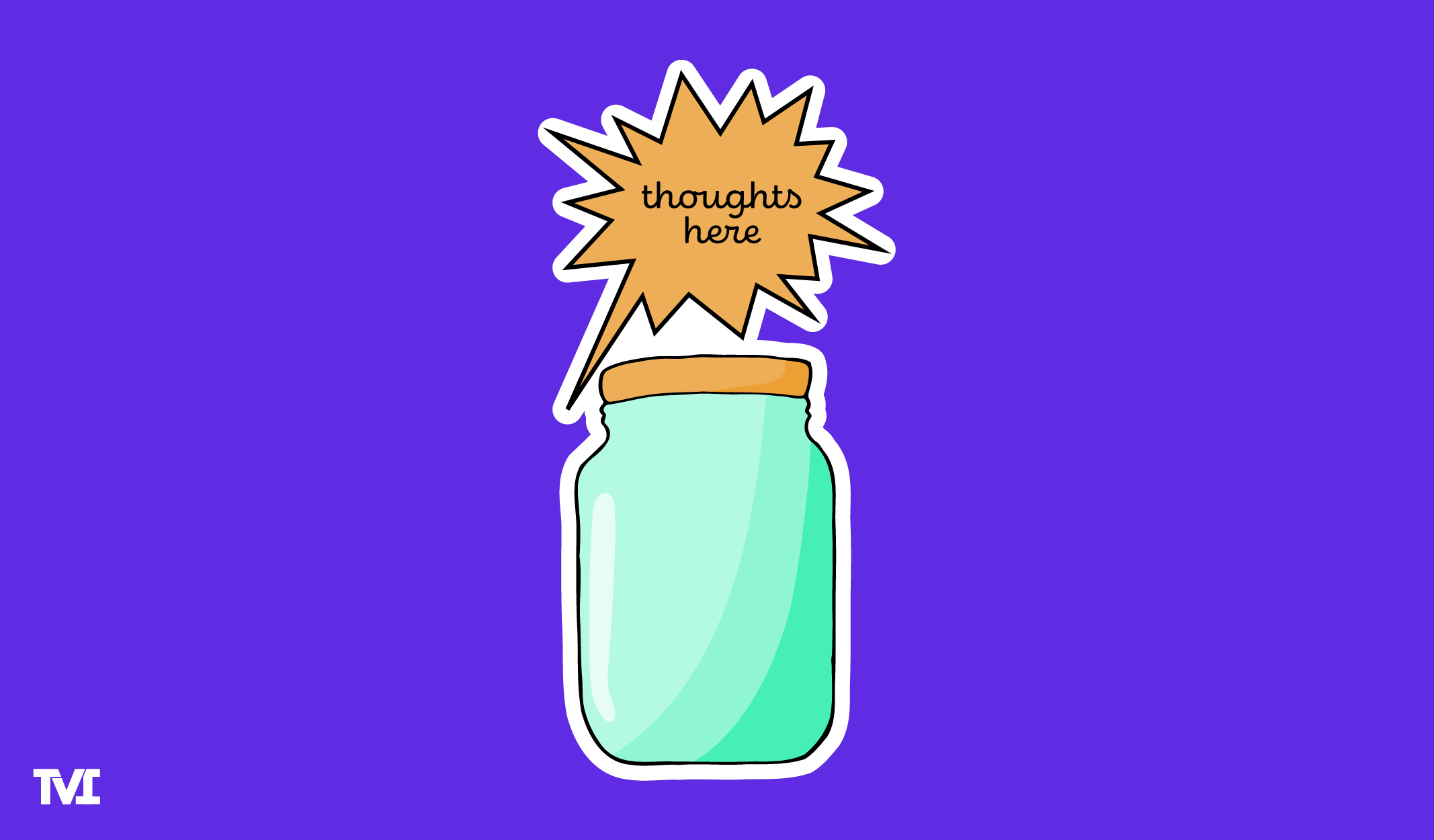
Put the thought in a jar
One of the more useful visualization techniques for fortune telling is to imagine taking the prediction out of your head and sealing it somewhere safe. Picture writing the thought on a slip of paper, labeling it with a date, and putting it in a jar.
This is not to say you should be bottling up your thoughts and emotions. Instead, you are storing them for when you actually know the outcome. To go back to the example I used at the beginning: I didn’t have to worry about my college roommate before I was actually assigned a roommate. So I imagined putting that thought in a jar with a label that read Post-Graduation, when I’d get my roommate assignment.
This works because a lot of fortune telling anxiety comes from feeling like you have to resolve something that can’t be resolved yet. The jar gives your brain time, space, and somewhere to put the thought that isn’t at the front of your mind.
Let the thoughts float by
Another approach is to imagine your fortune telling thoughts as leaves on the surface of a river. You can watch them drift past without grabbing onto them. If a prediction surfaces, you don’t have to engage with it or fight it—you can simply notice it and let it continue downstream, knowing you can collect it later when it’s actually relevant.
This technique is rooted in mindfulness practice, and it takes some getting used to. The instinct is to grab the leaf and examine it. With practice, you get better at watching it go. For further reading, check out these articles:


Talk back to the fortune teller
Fortune telling has a way of presenting itself as a neutral voice of reason, just being realistic, just preparing you for what’s coming. It helps to put a little distance between yourself and that voice.
Another visualization I find useful is to picture an actual fortune teller— crystal ball, dramatic lighting, fog machine, the whole shebang—and imagine that’s who’s feeding you these predictions.
When the thought comes, you can imagine the fortune teller delivering it to you, and you can respond with a polite but firm, “I hear you, but I’m not taking that reading today.” It sounds a little silly, but creating that separation between you and the thought has worked for me. The prediction stops feeling like your own clear-eyed assessment and starts feeling like what it actually is: a guess dressed up as a certainty.
Fortune telling is one of the harder thinking traps to detect, because it’s so natural (and often healthy) to daydream, fantasize, and prepare. But once you start noticing how fortune telling as a cognitive distortion can turn your harmless daydreams into self-limiting beliefs, you can find ways to adjust your thinking and stop closing doors you haven’t reached.