


You have the power to design how you are seen by the world, which is a bit intimidating if you ask me.
To be honest, I still get stressed out when I do a portfolio redesign or update my online profiles, and I’ve been building my personal brand for nearly a decade.
Finding quality inspiration helps relieve this stress, though, which is one of the reasons I wrote this post.
The other reason is that when I Google “personal brand examples,” all the posts list the same trite (and to be frank, overly spammy) people, so this is my attempt to outdo them with a way better list of the most authentic hidden gems out there.
Whether you need inspiration for your personal website, professional bio, or just some really cool photography ideas, this post has you covered. By the end of it, you’ll know all the different paths to craft a successful personal brand.
Shall we?
Personal brand celebrity examples
Kate Toon
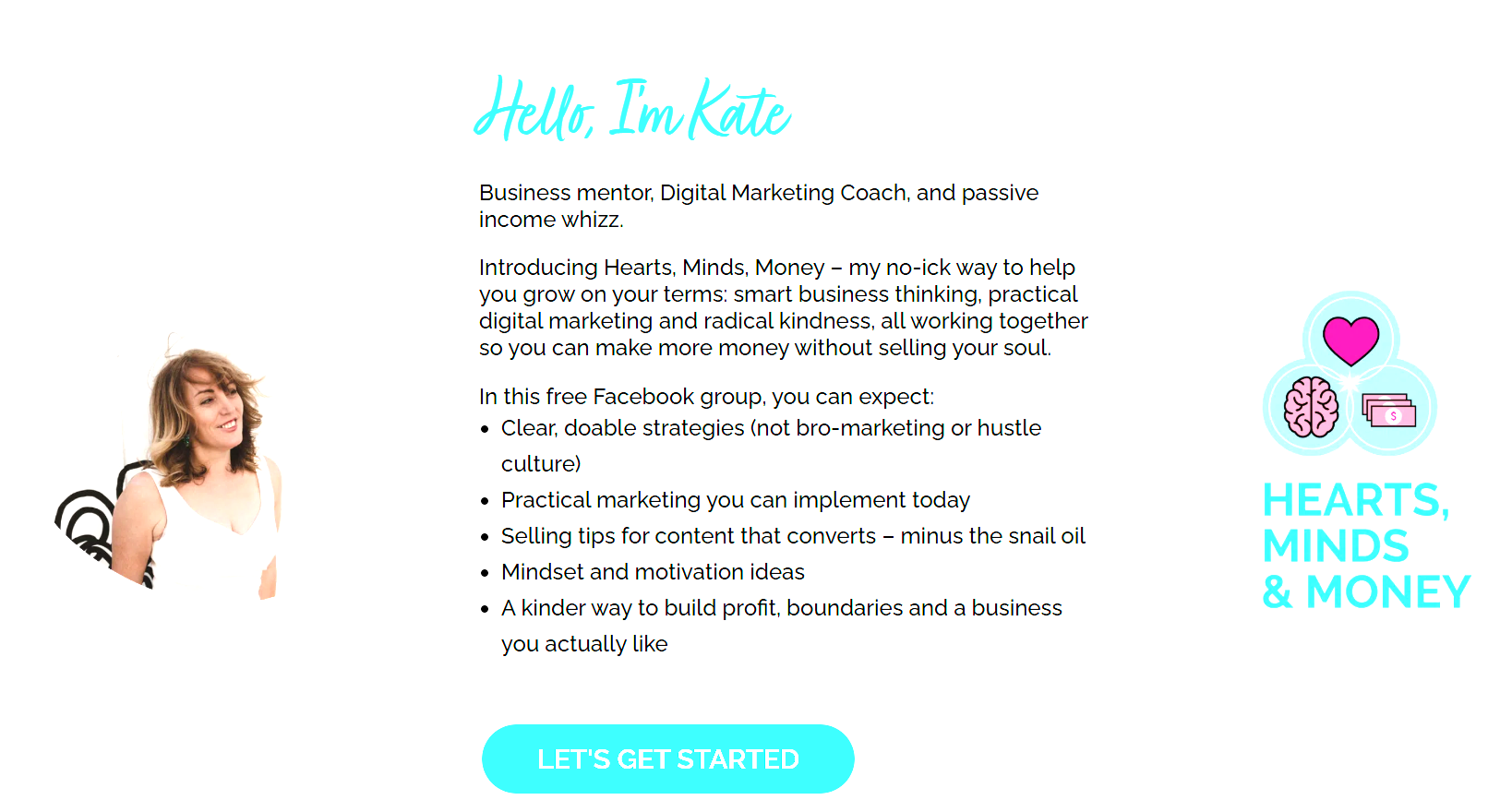
Kate Toon is one of the most well-known names in the freelance copywriting and SEO world, and she’s also a renowned public speaker. A huge part of her success can be attributed to her personal branding strategy, which is out of this world.
🔥 WHAT I LOVE ABOUT KATE
HER PERSONALITY IS FRONT AND CENTER
Kate is living proof that you can have a successful personal brand while still having fun and being playful. Throughout her website and the products she sells, you’ll see images of her with her family, on her own, and just having fun.

This is a brilliant strategy to make her not only stand out from the crowd, but attract people who will match her fun, vibrant energy.
SHE USES DIFFERENT MEDIA TO UNDERSCORE HER BRAND

Even though Kate’s specialty is the written word, she’s not afraid to step in front of the camera and showcase her personality with videos.
She also has her own podcast, a few training courses, a blog, a book—basically, she’s used every single medium you can think of to get her message across.
Of course, written text will be an important part of your personal branding—but don’t limit yourself. Try different mediums and see what resonates most with your audience.
Steven Pressfield

Steven Pressfield is a veteran author of several books, including the popular self-help novel The War of Art, which he’s since turned into a free course on his website.
Steven has been in the writing game for a long time, and his goal to inspire other budding authors is at the very center of his personal branding game.
🔥 WHAT I LOVE ABOUT STEVEN
HE FOCUSES ON HIS AUDIENCE
Though Steven shares his story and plaudits throughout his personal website, as you look through his site you’ll see that most of what he’s written is tailored for his audience of authors.

HIS BRANDING IS INCREDIBLY CONSISTENT
One of the trickiest things about personal branding is that once you turn it on, you have to keep momentum going to be successful.
Steven shows us how this is done—and if you subscribe to his email list, you’ll find out what I mean. Every Wednesday, without fail, Steven publishes a brand new blog and sends it out to his list.
And every week without fail, these blogs generate lots of buzz and conversation with his audience.

Marie Forleo
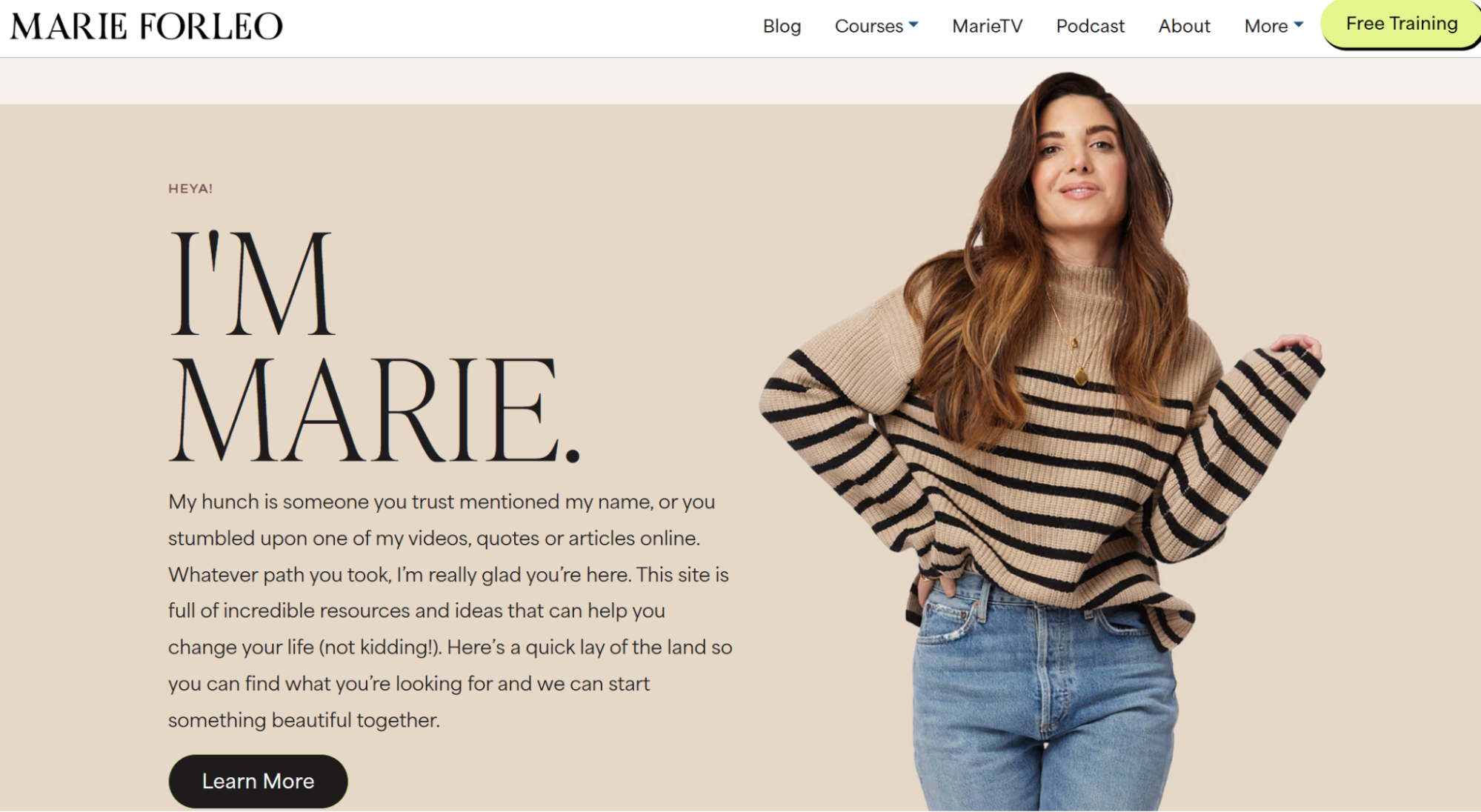
Marie Forleo is an American life coach, motivational speaker, author, and the host of Marie TV.
She is practically a full-fledged personal brand celebrity at this point, showing off pics with Oprah and Tony Robbins on her site.
🔥 WHAT I LOVE ABOUT MARIE
HER STORY IS COMPELLING, RELATABLE, AND MAKES SENSE
To be honest, I never exactly cared for Marie before I read this post on Business Insider about her.
The post shared her story about how she got into doing what she does today. Not only did I totally relate to her story, but I also began to see how the dots connected to who she is now. That helped me identify with her and instantly like her.
Before I read it, I tuned her out because she looked like just another self-help guru with big hair and perfectly concocted outfits.
This is why your story is so important. It makes people relate to you and therefore like you. It also allows you to explain your “why”—why you do what you do. Show me the passion, people!
You can get more inspiration for how to tell your own story on Marie’s about page.
Ramit Sethi

Ramit Sethi is the author of I Will Teach You to be Rich (a blog and a NY Times’ Best Seller) and the founder of Growth Lab, a place for entrepreneurs to learn how to grow their businesses.
🔥 WHAT I LOVE ABOUT RAMIT
HIS CONTENT IS PHENOMENAL
Ramit taught me everything I know about negotiation. I wholeheartedly believe if it wasn’t for Ramit’s content, I wouldn’t be making the money I’m making today, especially when half of my peers are underemployed or unemployed.
HE HAS A LIKABLE PERSONALITY
Ramit is like a cool nerd. He can teach you so much because he’s so smart, but he’s also extremely likable because he has a great personality that he injects into his brand (in his copy, videos, etc).
Personal brand examples for students
Lily Herman

Lily Herman is a freelance writer, editor, and digital strategist, and her work has been published on Teen Vogue, Allure, Glamour, Refinery29, TIME, Mashable, Business Insider, Cosmopolitan, ELLE, and more.
I discovered Lily’s writing on The Muse, and I included her because she’s a prime personal brand example for students.
🔥 WHAT I LOVE ABOUT LILY
HER WEBSITE IS SIMPLE YET IMPRESSIVE
Lily lets her achievements speak for her. Take a look at her bio:

Can you say, “WOW?!”
She opens with a long list of notable publications that any visitor would recognize, which makes you keep reading.
Then she breaks up her achievements into easy-to-digest bullet points, in which she QUANTIFIES things she’s done.
For example:
“From February 2013 to May 2016, Lily was the co-founder, editor-in-chief, and CEO of The Prospect (TP), the largest student-run college access organization in the world. The site had over 400 student volunteers worldwide (all under the age of 22) over the site’s three-year span and has had over 8 million page views to date.”
SHE LINKS TO EVERYTHING
You can easily stay in touch with Lily by following her on X account, Facebook or LinkedIn, and if you click through, you’ll notice she’s active on all platforms.


Her bio is also impressive, and she makes it easy for people to get in touch with her by providing a professional email address.
Kat Boogaard

Kat Boogaard is a six-figure freelance writer who has been published in places like, Forbes, Fast Company, TIME, Inc., Business Insider, The Muse, Trello, Mashable, and more.
🔥 WHAT I LOVE ABOUT KAT
SHE HAS A FANTASTIC PERSONAL WEBSITE
Kat’s website is consistently branded—the colors, her photos, even her Instagram pics. Everything matches beautifully.

Her website speaks to her two main audiences: newbie freelancers and potential writing clients.
For writing prospects, she features a clean portfolio page, and for newbie freelancers, she has her blog, where she teaches readers all about freelance writing.
SHE’S ACTIVE ON SOCIAL MEDIA
I follow Kat on X, and she’s quite active (and hilarious!), always injecting her personality into her content, making her even more likable.
Notice how her X cover photo totally matches her website design, and her bio mentions prominent brands she’s worked with. Impressive!

I highly recommend scoping out her LinkedIn profile and Instagram account as well. They will definitely leave you feeling inspired.
Personal brand examples for designers
Rogie
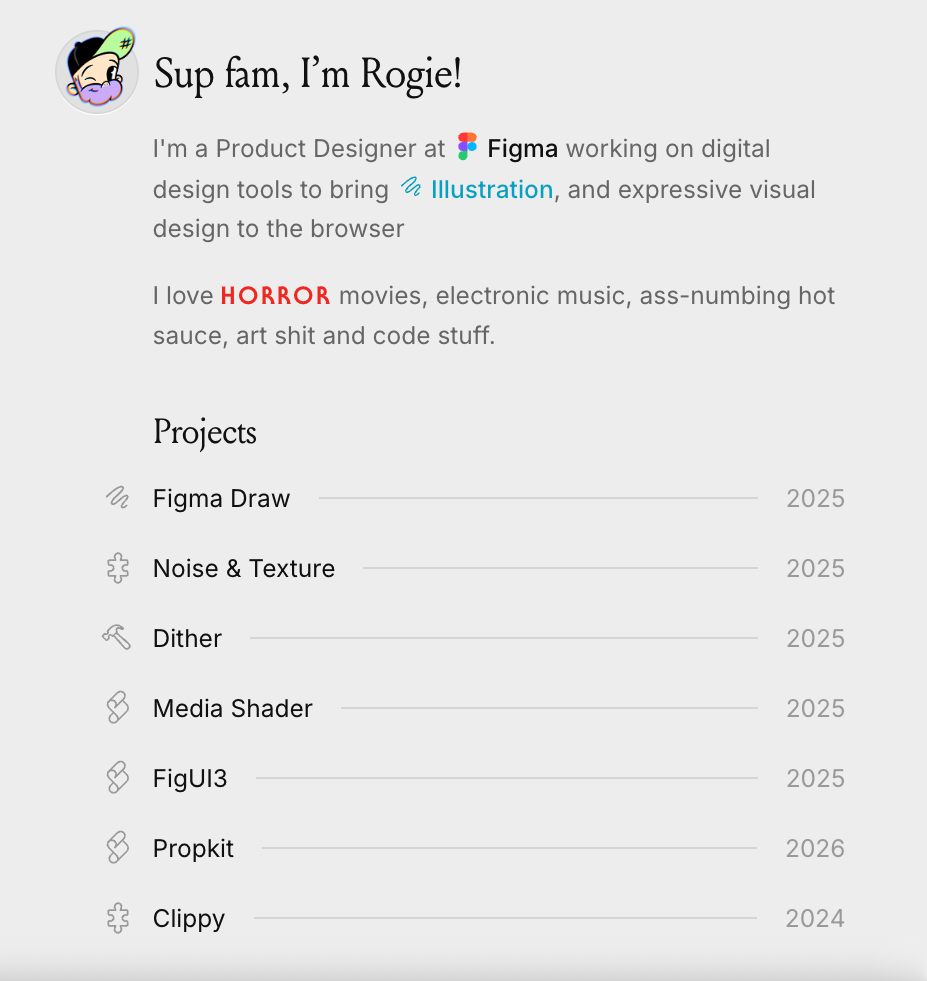
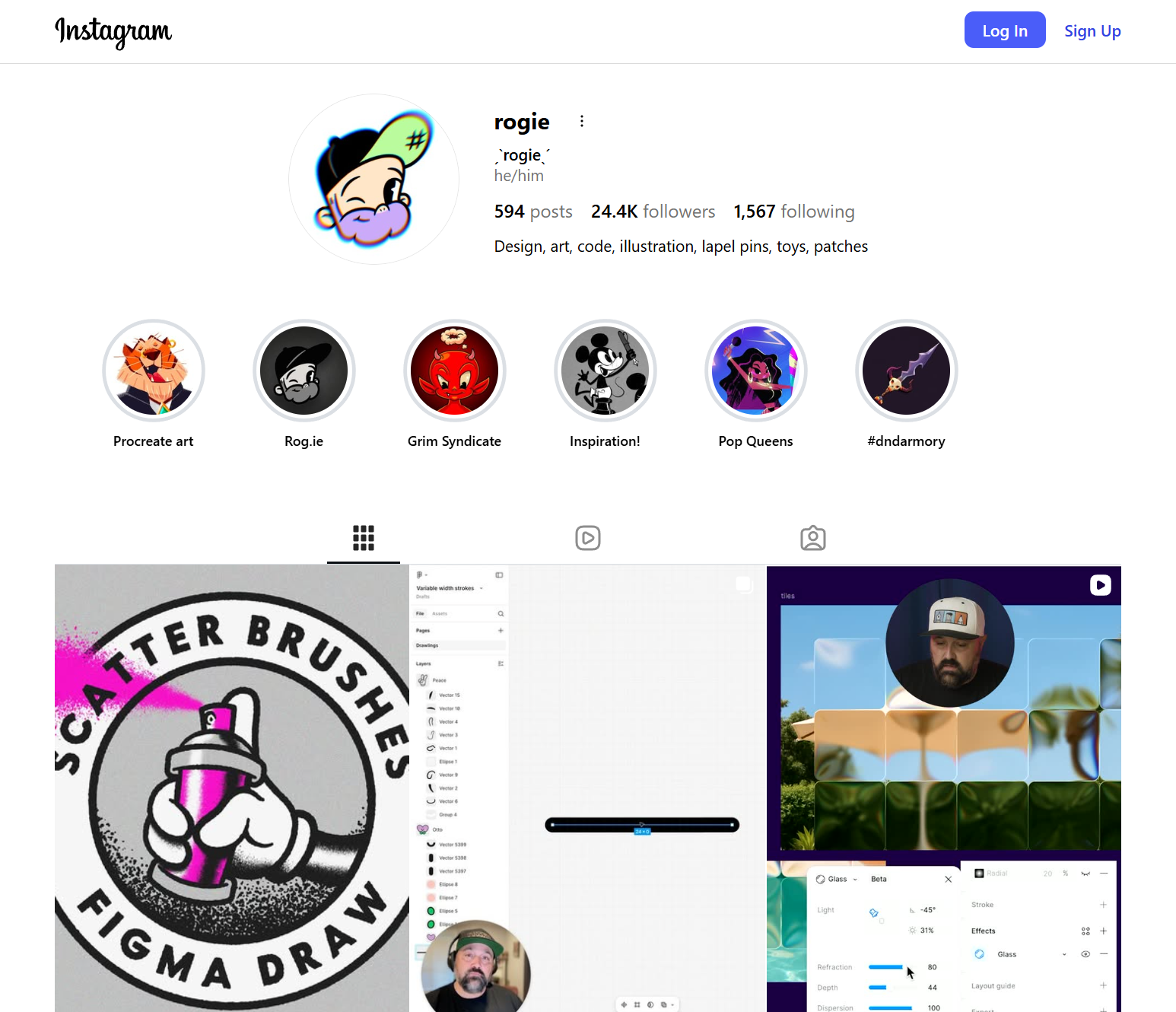
Rogie is a designer, illustrator, and developer I discovered on Dribbble. I’ve fallen in love with his work ever since.
🔥 WHAT I LOVE ABOUT ROGIE
HE HAS A UNIQUE, RECOGNIZABLE STYLE
You can spot Rogie’s work from a mile away because it’s so unique (and BEAUTIFUL!!).
When people can recognize your copy or designs like that, you’re doing something right—really right!
HE IS ACTIVE ON SOCIAL
Rogie is on all of the important social media outlets for designers/illustrators—X, Dribbble, and Instagram.
Pablo Stanley
 Pablo Stanley is the lead designer for InVision Studio. He’s a phenomenal (and LOL-funny) illustrator.
🔥 WHAT I LOVE ABOUT PABLO
HIS COMICS ARE FANTASTIC

I discovered Pablo when he started The Design Team, which is an LOL-funny Medium publication for designers.
This is a prime example of a phenomenal side project that nonchalantly promotes his skills. I would argue it’s his claim to fame.
HE’S ACTIVE ON SOCIAL MEDIA

Pablo has massive followings on X and YouTube, and for good reason—he teaches design, which in turn gets him more clients/opportunities.
HIS PORTFOLIO IS SIMPLE YET IMPRESSIVE
Like Rogie’s site, Pablo’s is a simple, traditional portfolio that showcases his best work and side projects. This is another example of “social proof.”

Personal brand examples for freelancers
Austin L. Church

Austin L. Church is a coach and mentor for freelancers, and the creator behind Freelance Cake, a resource hub and mentorship program for freelancers and consultants.
🔥 WHAT I LOVE ABOUT AUSTIN
HE IS SUPREMELY APPROACHABLE
Austin knows his target audience well—they’re folks who are building up their own empires, and struggling with all of the stress, imposter syndrome, and anxiety that comes with that.
Throughout his personal branding, Austin uses extremely approachable language and his own friendly face to help his visitors understand and those fears to get in touch.

HIS NEWSLETTER IS CONSISTENT AND TOP-NOTCH
Austin runs a weekly newsletter (and he also posts excellent content on LinkedIn almost daily). Even if you aren’t a paying customer of his, his newsletter is full of value that acts as an extension of his personal brand and builds trust.
Michal Eiskowitz
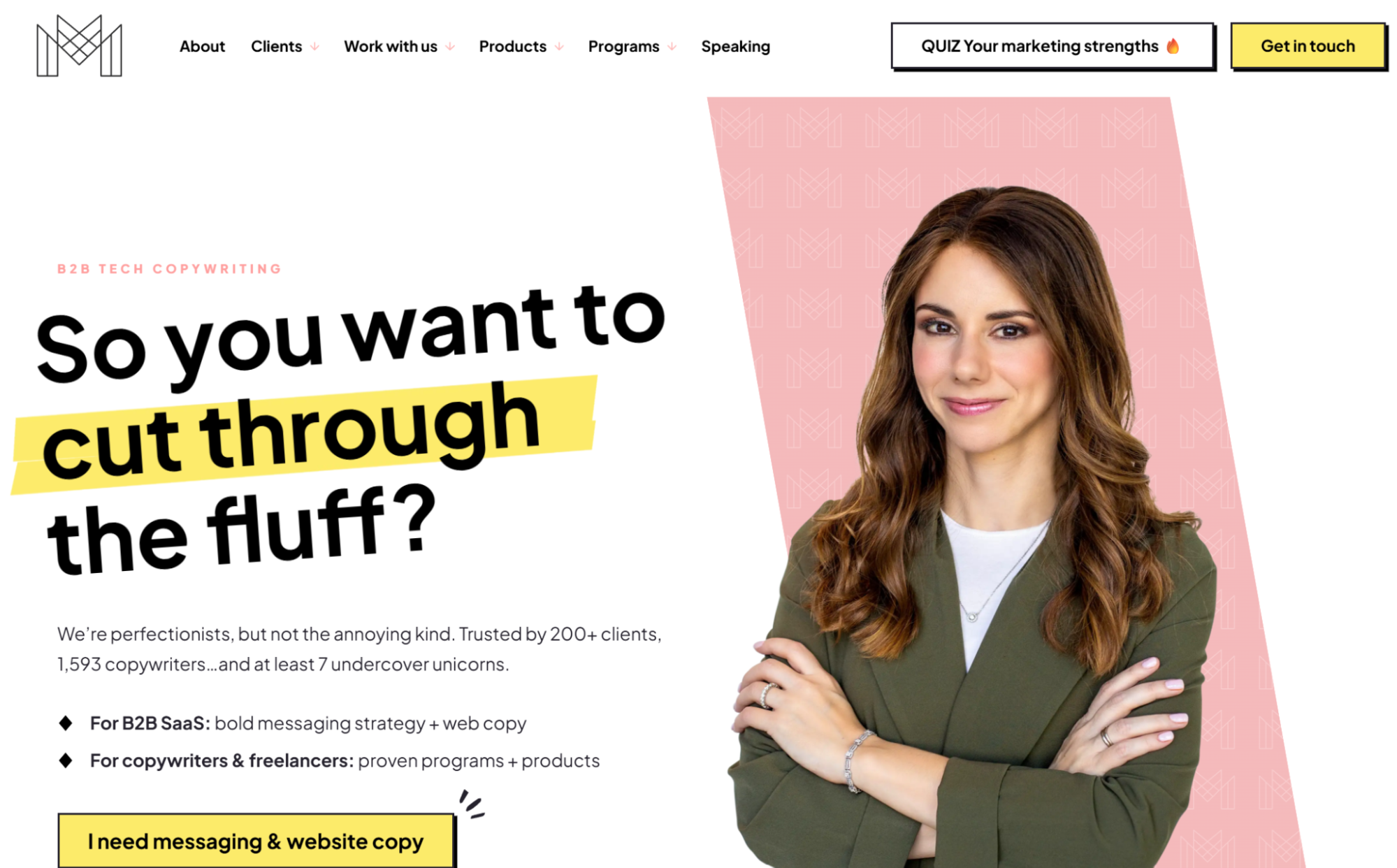
Michal Eiskowitz is a well-known freelance copywriter, a public speaker, and she helps other freelance copywriters get more leads and level-up their businesses. She does all that with a personal branding style that is simply exquisite. You only need to spend a few moments on her website before her personal brand becomes crystal clear.
🔥 WHAT I LOVE ABOUT MICHAL
SHE INVESTS IN STELLAR DESIGN
When you scroll through Michal’s website, it’s easy to see she understands the power of high-quality design. She has hired some excellent brand specialists to create a website that is aesthetic, has an excellent user experience, and plenty of fun along the way.

SHE KNOWS HOW TO MARKET A PRODUCT
Michal not only offers her writing skills to businesses, but also recruits other freelance copywriters by selling some irresistible products. The landing page for her primary product, her Copywriting Pricing Guide, is a masterclass in how to sell a digital product.

Sarah Duran
Sarah Duran is an independent COO and business coach for solo business owners, and the founder of Fruition Initiatives, a platform built to help freelancers and solopreneurs scale on their own terms.
🔥 WHAT I LOVE ABOUT SARAH
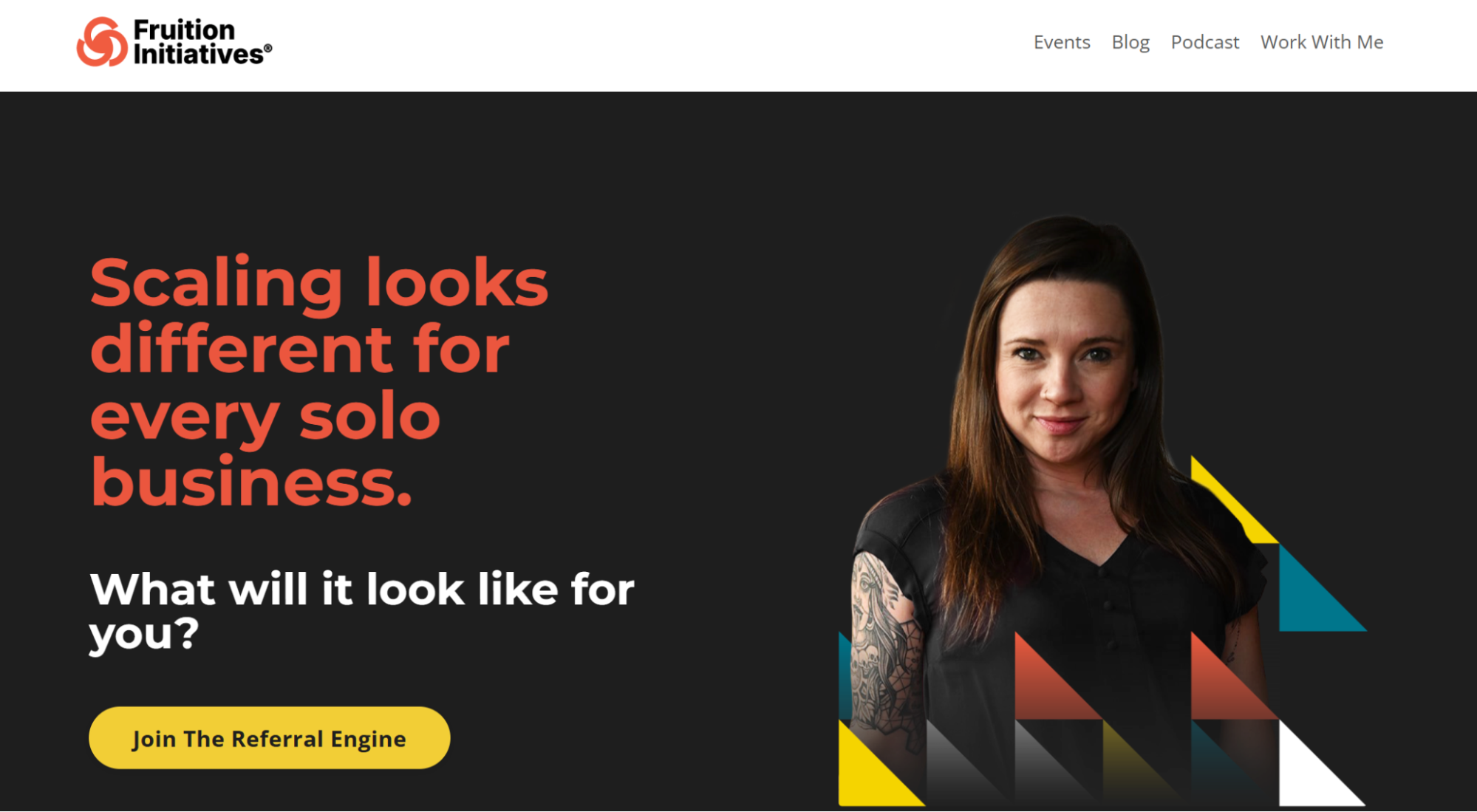
HER BRANDING IS DIALED IN ACROSS EVERY PLATFORM
From her website to her LinkedIn profile, Sarah’s brand is immediately recognizable — bold, dark design, sharp messaging, and her own face front and center. Nothing feels out of place from one platform to the next.
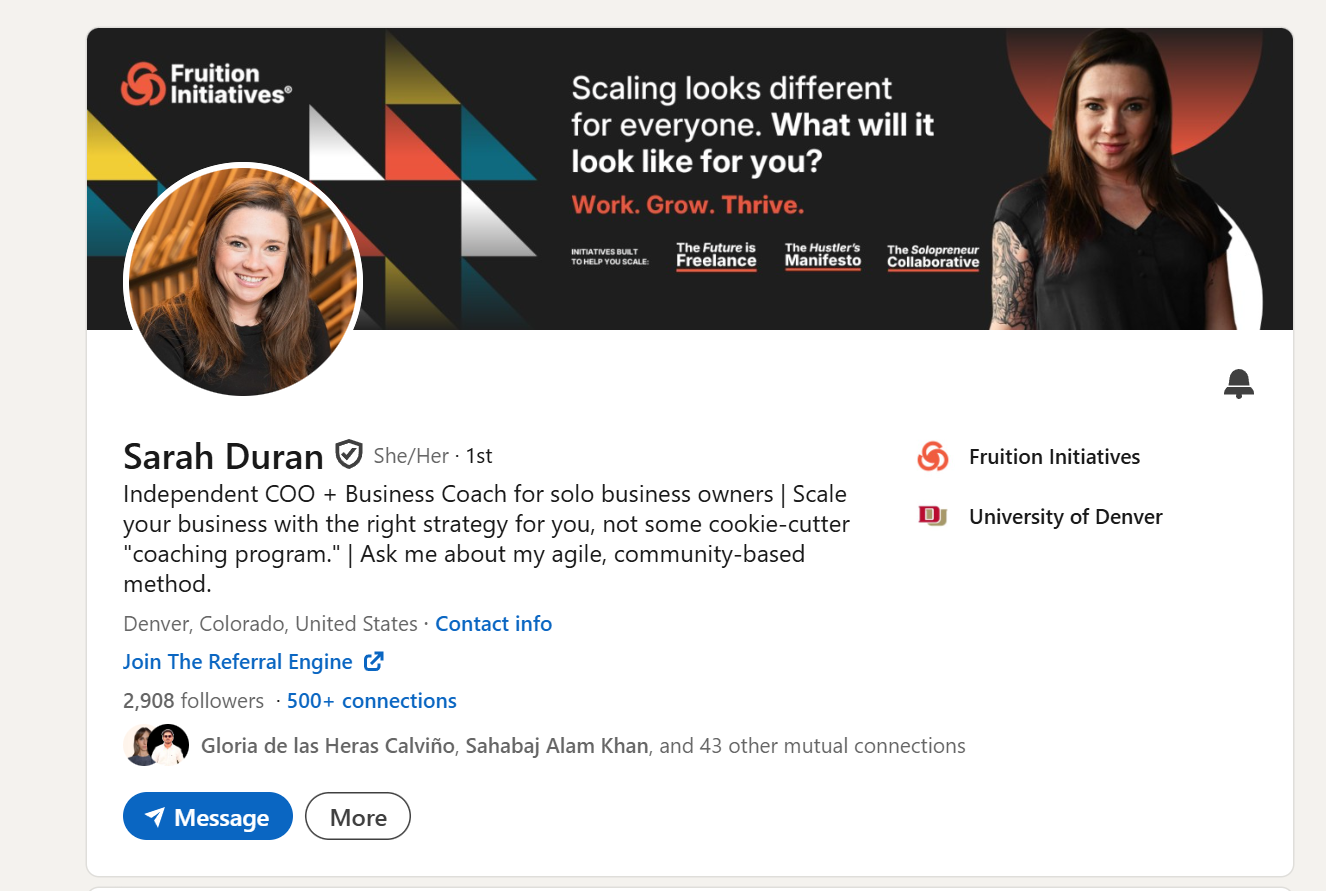
That kind of consistency builds trust fast. Visitors know exactly who she is and what she does before they’ve read a single word.
SHE USES COMMUNITY EVENTS TO BUILD HER AUDIENCE AND CONTENT LIBRARY
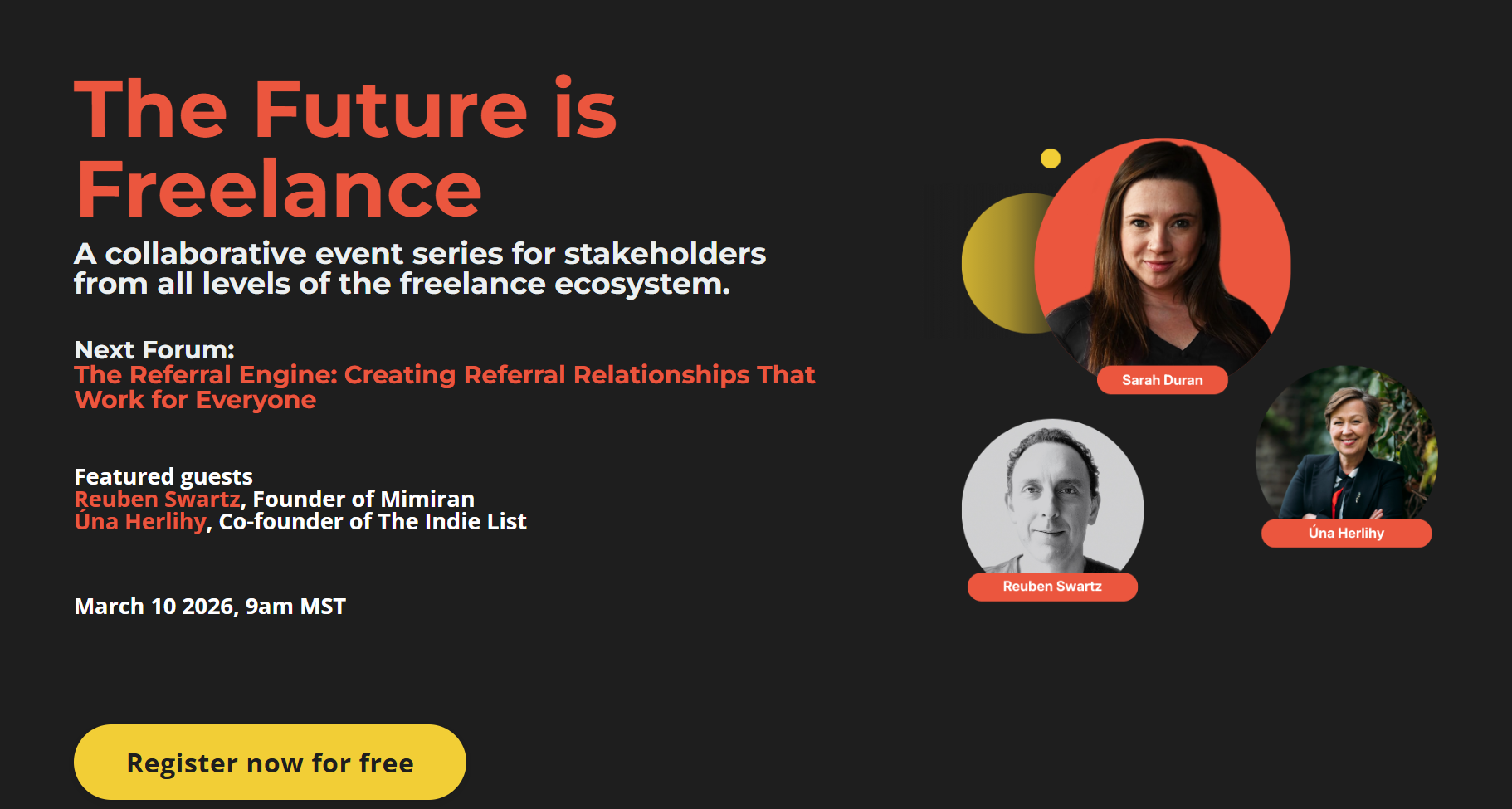
Sarah runs The Future is Freelance, a podcast and collaborative event series for everyone in the freelance ecosystem. Each forum tackles a real topic—like how to pivot your business or take long-term leave as a freelancer—and brings in expert guests to dig into it.
The result is a content library that keeps growing with every event, while simultaneously growing her audience. Her current community, The Referral Engine, is the latest iteration of that strategy—and it’s a smart one.
Anna Burgess Yang
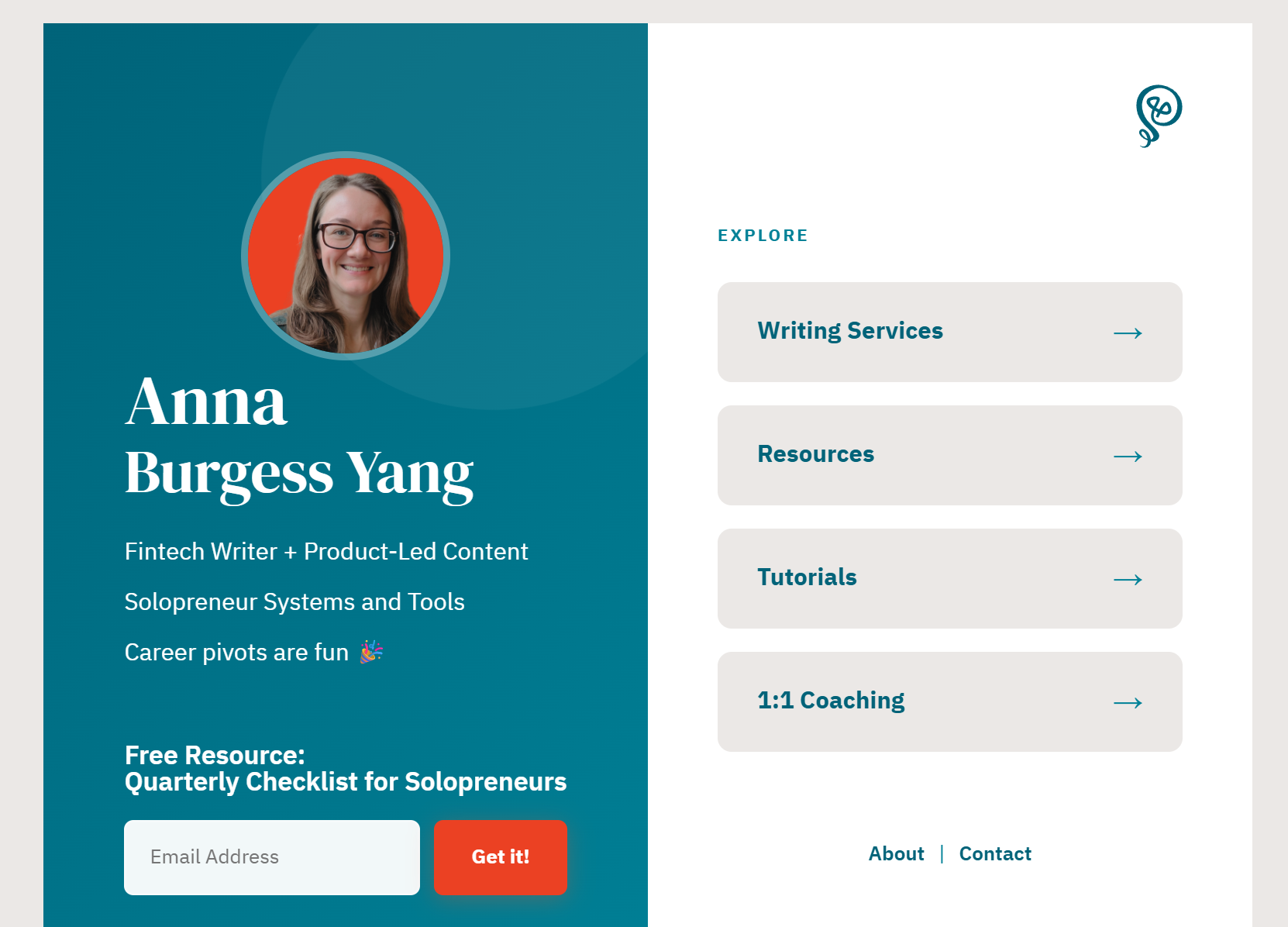
Anna Burgess Yang is a fintech writer and solopreneur systems expert who has built a personal brand that proves that sometimes simple design is the most effective.
🔥 WHAT I LOVE ABOUT ANNA
HER SITE IS SIMPLE, BUT THE VALUE IS ANYTHING BUT
Anna’s website, which she vibe coded herself, is clean and no-frills — but every corner of it is packed with useful content. Writing services, tutorials, resources, coaching — it’s all there, neatly organized and easy to navigate. The design gets out of the way and lets the work speak.
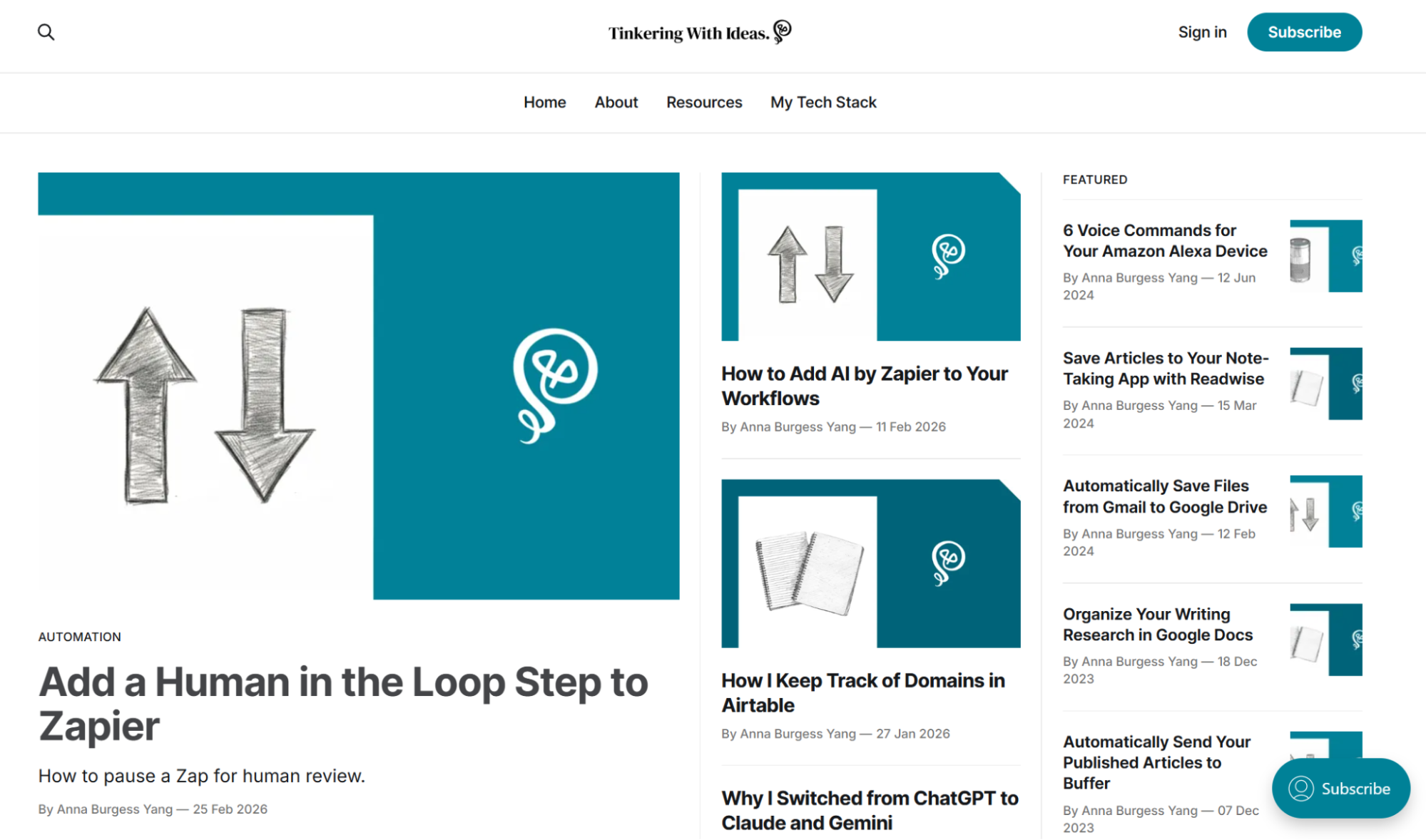
SHE HAS A SERIOUSLY SMART MARKETING ENGINE
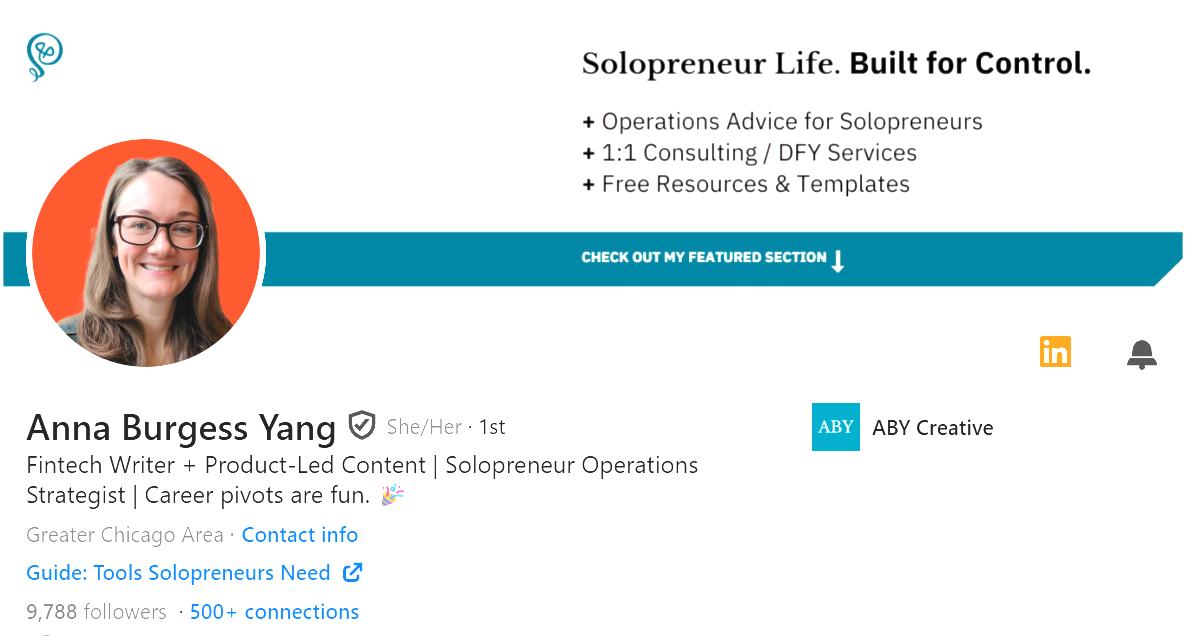
Anna has built an automated system that keeps her content—and her name—consistently in front of people on LinkedIn. While many freelancers are posting manually and burning out, Anna has engineered a workflow that does the heavy lifting for her. The result is a steady, visible presence that makes her nearly impossible to forget.
It’s a masterclass in working smarter, and for anyone building a personal brand on limited time, it’s worth paying close attention to.
Elina Jutelyte
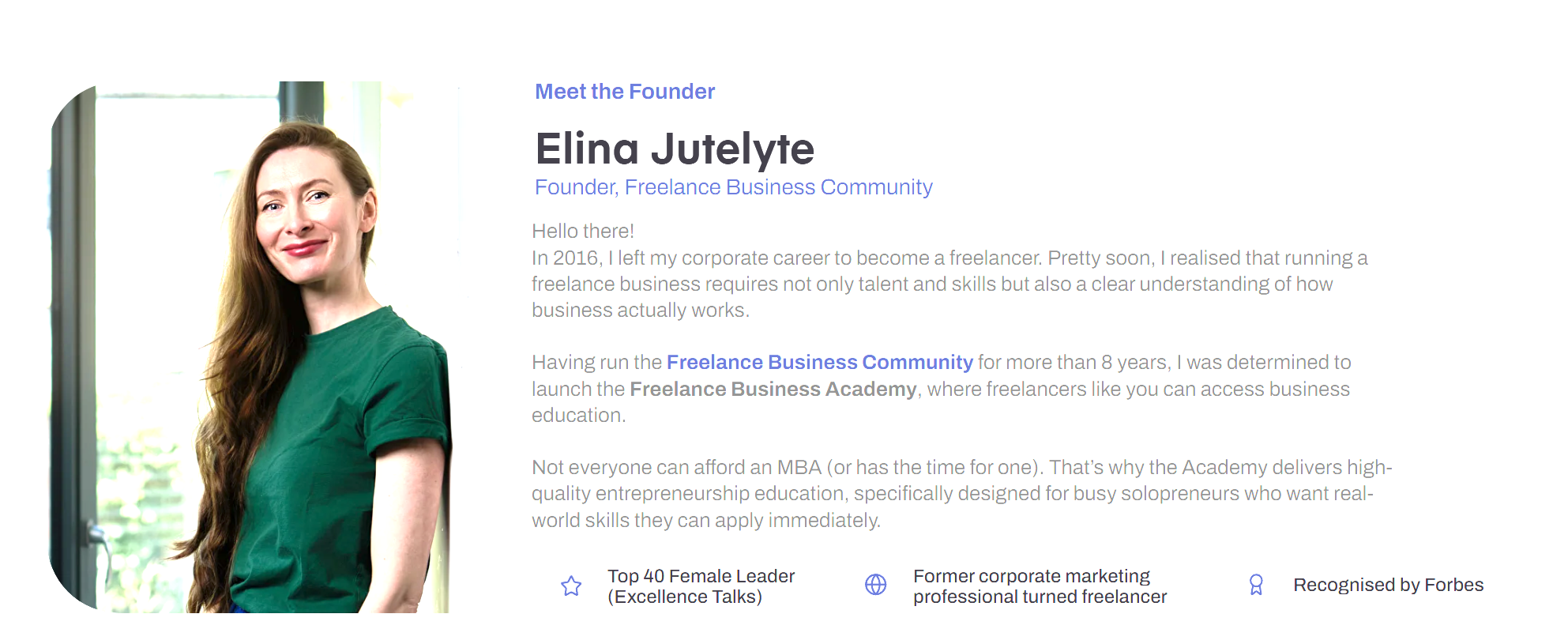
Elina Jutelyte is the founder of the Freelance Business Community and the Freelance Business Academy, a business education platform built specifically for solopreneurs who want real-world skills they can actually use.
🔥 WHAT I LOVE ABOUT ELINA
SHE USES COPY TO CALL OUT EXACTLY WHO SHE’S TALKING TO
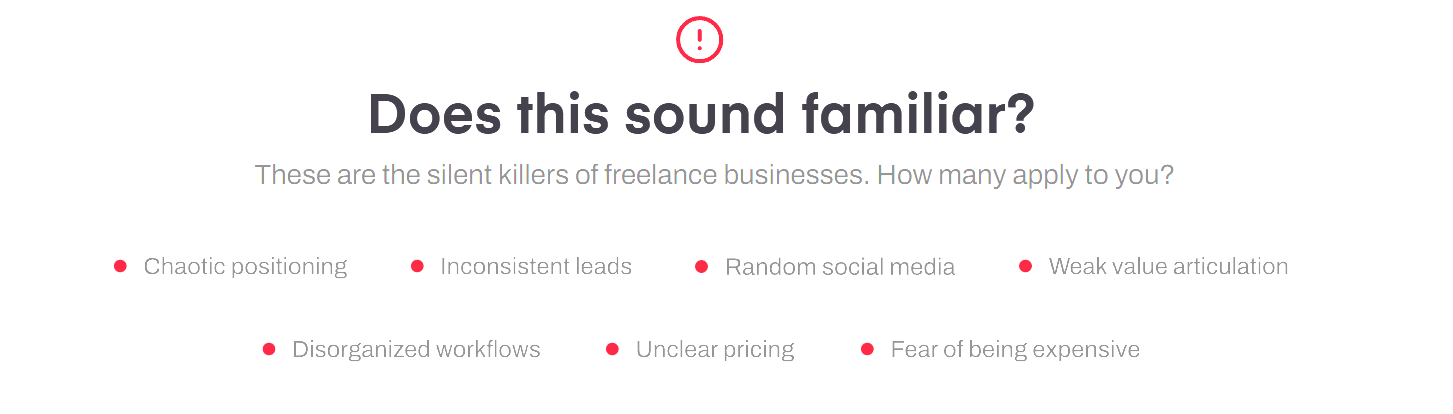
Elina’s website does something a lot of personal brands get wrong — it speaks directly to the pain points her audience is already feeling. She names the problems freelancers face (“chaotic positioning,” “inconsistent leads,” “fear of being expensive”) before she ever pitches a solution. By the time you get to her Academy, you already feel like she gets you.
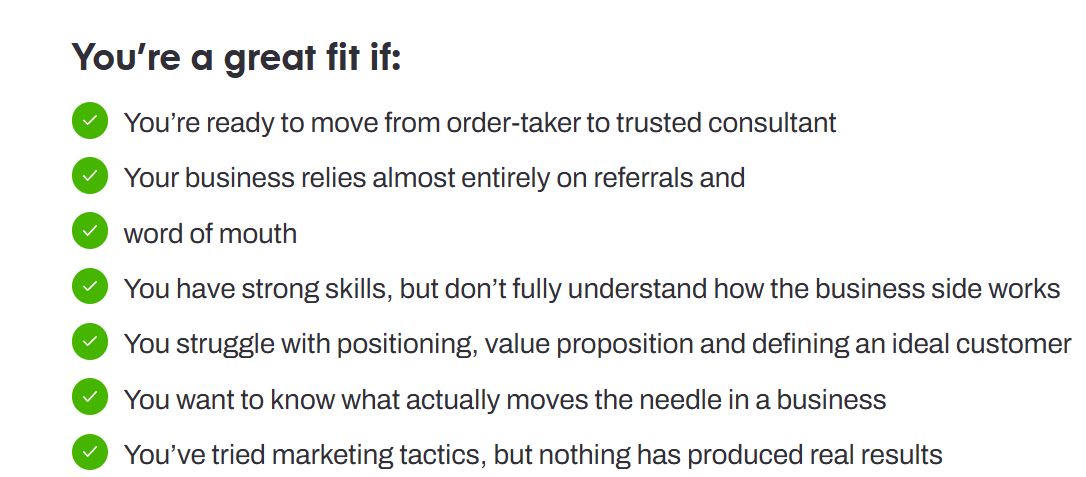
SHE’S CRYSTAL CLEAR ABOUT WHO’S A GOOD FIT
Rather than trying to appeal to everyone, Elina lays out exactly who her program is designed for. That kind of specificity does double duty—it attracts the right people and builds immediate trust with them.
How to launch your own personal brand
Hopefully, now that you’ve read through all these awesome examples, you’re feeling energized and ready to start building or refining your own personal brand.
To help, I’ve compiled the biggest takeaways from these examples, so you can use them as inspiration on your personal branding journey.
Use your personality and story as your foundation
If there’s one thing all of these personal branding examples have in common, it’s this:
Personality should be at the core of all personal branding strategies.
In fact, this is one of the most fun and exciting things about creating a personal brand; you can use your genuine personality to attract the kinds of clients and followers you want in your network (and even drive away those you don’t).
To get started with this, think about what makes you unique. Try answering these questions:
- Where did I grow up, and how did that influence who I am?
- What am I most passionate about?
- What are my personal convictions and beliefs?
- What would my friends/family say about my personality? (Pro tip: If you aren’t sure, ask them!)
- What are the things that make me weird/quirky/unusual?
- What kinds of personality traits do I want or expect in the people I surround myself with?
- What kinds of personality traits do I not tolerate in my life?
Meditating on these questions will help you gain a deeper understanding of what makes you you. Once you have these answers, it will be much easier to inject your personality into the copy on your website and social media pages.
Tailor your messaging for your ideal audience
Once you have nailed down how you want to portray your own personality within your personal branding, it’s time to shift gears and think about the people you’re talking to.
Personal branding is all about connections—whether you’re looking to bring in new clients to your business or simply create a recognizable brand that will help you find your next job.
For personal branding to do its job, it’s vital that you have a deep understanding of who your audience is, what they’re thinking about, and what they want.
Again, you can ask some simple questions to start getting a deeper understanding of your audience:
Start by listing out the basic demographics of who your audience might be:
- What is the general age range of your audience?
- Where is your audience located?
- Is your audience more likely to be male, female, or a blend of genders?
- What job titles do your audience members have?
- What is the average income of your audience?
These basic stats can help, but the real magic comes when you go a level deeper with questions like these:
- What issue is my audience facing right now?
- What does my audience want right now in their life?
- What past experiences have colored my audience’s perspective?
- What does my audience need right now?
- What’s keeping my audience awake at night?
- What brings my audience joy and satisfaction?
You can probably think of the answers to some of these questions on your own, but you’ll have more success if you do comprehensive research. Look for studies and statistics about your audience for starters. Then take it further by getting in touch with people who fit your ideal audience profile and interviewing them.
You can do this by posting a poll on social media, for example, and getting in touch directly with people who answer to ask follow-up questions.
If you already have a following on social media or through email marketing, you can even make a quick survey asking some of these questions and send it out to your list.
Once you have this deep information about your audience, tailor every message you have on your website or social posts to address them directly.
Make it consistent across every channel you use
When it comes to personal branding, consistency is key. If you’re using more than one channel to promote your brand (and you should be), then it’s important that the look and tone of your personal branding spaces is the same from one place to another.
Note: This does not mean you need to be on every single social media platform. In fact, doing so will likely spread you too thin and make it impossible to keep your branding consistent.
Instead, focus on the channels where you know your audience is likely to hang out. If you’re a freelance photographer, your personal branding should probably extend to Instagram and Pinterest. If you’re working in a B2B field, LinkedIn is likely the way to go.
Of course, a personal website can go a long way toward building a personal brand—and the nice thing about a website is that you own it completely, and you won’t have to worry about a social media algorithm or policy changes making it hard to brand yourself there in the future.
But even if you don’t have a personal website, you can still launch a personal brand through the social media channels you’re already using.
LinkedIn is one of the best places to start building a personal brand, and we have some excellent advice for you if you want to get started there:


Use social proof to demonstrate your skills
Telling your audience that you’re good at what you do is one thing. But showing how good you are is really what matters.
There are so many ways you can showcase your skills throughout your personal branding by using testimonials, case studies, and a strong portfolio.
If you’re just getting started, this may be a challenge—perhaps you don’t have any work examples to show yet. If that’s the case, your focus should be on building some social proof as soon as you can.
First, think if there is anyone who would be willing to provide a testimony, even if they weren’t your customer. Perhaps a former colleague, professor, or mentor would be willing to give you a quote you can feature on your site.
Remember that your portfolio doesn’t only have to consist of paid work. If you’re a writer, for example, publishing a few blogs about your expertise on LinkedIn or Medium, and then linking to those in your portfolio, will work well.
Whenever you finish work with a client, don’t be shy about asking for a testimonial. It’s as easy as putting in an email, “Would you mind giving me a quote about your experience working with me? I’d love to feature it on my profile.” You’ll be surprised how many people are happy to give you feedback you can share to boost that social proof.
Remember, your personal brand is yours to mold however you like. Keep your personality at the core and speak directly to your audience, and you’ll already have a great start. Happy branding!







MT777 says:
I loved the different personal brand examples! It’s amazing how a strong personal brand can create such a powerful impact. Looking forward to implementing some of these strategies.
Anna Schmohe says:
Glad it was helpful and good luck!
RP66 Website says:
The tips on authenticity and consistency are especially valuable. Looking forward to applying some of these strategies myself!
Anna Schmohe says:
It’s an ongoing effort – good luck!
Unduh HALO777 says:
This post really highlights the power of personal branding! I love how you showcased diverse examples that illustrate different approaches.
Anna Schmohe says:
Happy branding!
Y2mate says:
I particularly loved the examples you shared; they really illustrate how authenticity plays a crucial role in building a strong brand. Thank you for sharing!
Anna Schmohe says:
Keeping it real is the way! Glad you enjoyed it.