Have you heard the term HENRY—high earner, not rich yet? It describes people with all the outward trappings of success but little actual wealth or equity to show for it. They earn good money, yet they’re still living paycheck to paycheck.
The mental shift that separates true wealth-builders from HENRYs often comes down to one question:
What do you think money is for?
Some people treat money mainly as a way to cover the essentials—to get by. Others, including a lot of HENRYs, treat it as a way to fund a lifestyle, often taking on debt to buy things they don’t really need. But wealthy people treat money as a tool to make more money—something to put to work for them rather than simply spend.
For many high earners who feel perpetually stuck, the problem isn’t the size of the paycheck; it’s an unexamined assumption about the purpose of money.
Why HENRYs stay stuck
If you look at the typical HENRY, they look successful—nice car, nice house, well-dressed—but they lack real wealth or equity. This happens for a lot of reasons.
Keeping up with the Joneses. Trying to impress their peers. Willing to go into debt over appearances. They’re buying more house than they actually need, and they’re not putting their money into places that can help them earn more money.
I’m not knocking having nice things. But how you get those nice things does matter.
I first learned this from Robert Kiyosaki in his book “Rich Dad, Poor Dad.” There’s a difference between how “high earners, not rich yet” buy luxuries and how the truly wealthy buy luxuries.
HENRYs use their income and credit in order to buy luxury items.
Rich people pour that income into investment vehicles that generate cash flow back to them.
Example: You take a portion of your income and invest in real estate. The property earns rent, and your tenant’s payments chip away at your mortgage—so over time you’re building equity partly on someone else’s dime. It’s not effortless money: there are vacancies, repairs, and the occasional bad month. But managed well, it throws off cash and grows your net worth at the same time.
Years later, that equity and cash flow add up to a real cushion. You move some of it into something steadier and lower-maintenance—Treasury bonds, say—that pay interest without any work on your part.
Now each layer feeds the next: The rental income builds the cushion, the cushion funds the bonds, the bonds pay you to do nothing, and that income can go toward the next move.
This is how you can enjoy what you’re spending money on without the consequences of going into debt or sacrificing your income.
Fragile, robust, anti-fragile
Another thing that separates HENRYs from the truly wealthy is how their money is built—whether it’s fragile, robust, or antifragile. The idea comes from one of my favorite books, “Antifragile” by Nassim Taleb.
A glass vase is fragile: drop it and it shatters. A rock is robust—shake it, knock it around, nothing changes. Antifragile is the rare third category: things that actually gain from disorder. Entrepreneurship is a rough example. It’s chaotic and volatile, but that same volatility is what creates the upside.
The HENRY looks stable but is secretly fragile. Living paycheck to paycheck and carrying debt only works as long as the paycheck keeps coming. It assumes the job is secure—and the moment it isn’t, the whole structure collapses. Worse, many HENRYs never built the skills to go out and generate income on their own, so when the job disappears, there’s no fallback.
Taleb calls this the Turkey Problem. A turkey is fed every day for 364 days, growing more confident with each meal that life is good and getting better.
The 365th day is Thanksgiving.
That’s the slippery slope of being a high earner, not rich yet; you can quickly become a high earner, soon to be poor. I’ve watched it happen to people on LinkedIn who earned well for decades, saved nothing meaningful, and then got laid off. Some of these folks end up posting GoFundMes and publicly begging for work.
Part of the trap is how HENRYs save. Cash sitting in a checking account isn’t really saving; inflation eats it a little more every year because it isn’t earning anything. Even the savings they do have can evaporate within a year of a layoff.
The wealthy are often safer precisely because they don’t feel safe. There’s a theory (which I fully believe) that adding too many street signs can actually cause more accidents, because drivers tune out and stop paying attention. The entrepreneur is the opposite: When your livelihood rides on your own decisions, you can’t afford to stop watching. The vigilance IS the safety net.
Many people confuse risk with volatility. A business today—especially in 2026, when many require no inventory, no storefront, little upfront capital—can be a calculated bet. There is a known, limited downside and a large potential upside. Taleb calls this convexity. You’re not gambling blindly; you’re risking a small, defined amount on yourself for a shot at a much bigger return.
Assets vs. liabilities (your home is not what you think it is)
Here is another from Robert Kiyosaki about the difference between assets and liabilities. A big part of what separates HENRYs from the wealthy is what they count as an asset in the first place.
Kiyosaki’s most provocative claim is that your home isn’t an asset—it’s a liability. That cuts against almost everything popular culture says about homeownership, and when I’ve raised it with people, some folks get genuinely upset. So let me be clear up front: This isn’t an argument that buying a home is a mistake. It’s an argument for being honest about the math.
The usual case for buying is “you’re throwing money away on rent—at least a mortgage builds equity.” But that story skips over how a mortgage actually works. On a standard amortization schedule, the first years of payments are mostly interest; you barely touch the principal until the back half of the loan.
So someone who buys, lives there five years, sees the market tick up, and feels like they made money often hasn’t. Economist Robert Shiller’s long-run home price data shows that after inflation, home values have historically appreciated only marginally—and once you net out interest, maintenance, repairs, and property taxes, many homeowners are closer to break-even than they think.
A home is also illiquid. Short of a home equity loan, your money is locked in the walls. A stock portfolio, by contrast, you can sell whenever you want. The wealthy often borrow against investments to fund a purchase while their money stays put, keeps compounding, and isn’t taxed in the process.
Then there’s opportunity cost. I was debating this with two friends—one a homeowner, one an entrepreneur. The homeowner made all the standard arguments for buying. Our pushback was simple: That same capital might do more work elsewhere.
The $30,000 going toward a down payment could instead go into something with a faster return. Even while “wasting money” on rent, you come out ahead because you (a) take on no mortgage interest, (b) earn a higher return on liquid capital, and (c) keep the flexibility to move your money around.
This is the Turkey Problem again—the quiet assumption that home values only go up and the economy stays good. When 2008 arrived, people were underwater on houses they couldn’t afford, and the equity they thought they had was gone.
None of this means real estate is bad; it’s all about how you hold it. My homeowner friend actually gets this. She bought a house and rented the spare rooms to other women in town. Now the rent covers her mortgage, she pockets cash every month, and she’s building equity at the same time.
That’s the whole distinction: a primary residence pulls money out of your pocket every month, while the same building, operated the way she runs it, puts money in. Same house, opposite direction of cash flow. That’s what turns it from a liability into an asset.
Status games vs. wealth games
This is something that Naval Ravikant talks about.
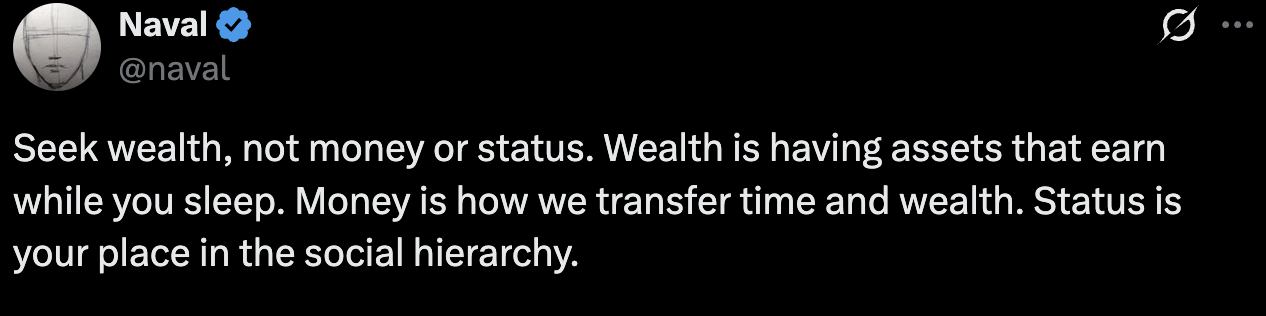
A lot of people I talk to are terrified of losing status, so they won’t promote their own business. One of my clients was a managing director at one of the biggest real estate firms on earth. After angel-investing in startups, coaching CEOs, and managing billions in assets, he had real expertise. The kind that builds an audience and brings in clients. But he refused to post online, full stop, because he was worried what other people would think.
Ever heard of climbing cringe mountain? It’s the idea that you have to be a little cringe to make it. You do things in public and risk shame, failure, and embarrassment. People watch you try to build something in real time—and watch you stumble at first.
The reality is most people who start a business do quit, and most don’t succeed, so the skeptics aren’t being unreasonable when they don’t believe in you early on.
The difference is made by the people who keep going anyway, though “keep going” isn’t quite right on its own. The ones who make it don’t just grind harder at the same thing; they adjust, learn from what flops, and change course when something isn’t working. Once you get to the top of cringe mountain, where you’ve actually done the thing, suddenly the same people are asking how you pulled it off.
To get there, you might have to ditch the golden handcuffs, leave the cushy title, downsize the house, sell the car, and look bad in front of your friends along the way.
Nobody is thinking about you as much as you’re thinking about you
Another truth to remind yourself of regularly: Nobody cares.
When I first started writing and building online, almost no one noticed—partly because I didn’t talk about it IRL. I might get the occasional “how’s that writing thing going?” Fast forward ten years and people now know me as the guy who does well financially. I wasn’t optimizing for how it looked early on; I wanted autonomy and ownership, and today I have a lot more financial flexibility and control because of it.
So ask yourself: “What kind of game am I playing?”
The status game is…
- Buying the expensive car instead of opting for the frugal option and investing the difference.
- Splurging on designer clothes but balking at the price of a course.
- Not wanting to be seen as someone who hired a coach, because the average HENRY sees that stuff as a scam.
But the real scam is thinking that you need to keep up with the Joneses in the first place. Or that attending university (and taking on enormous debt) is the only way to get ahead. Or that relying on an employer is the most responsible and stable path.
Related:



The “I deserve it” trap
I see it all the time, especially because I work with career coaches and help them grow their businesses, which means I spend a lot of time on LinkedIn. And I’ve found there is extreme entitlement among MANY job seekers.
They’re entitled because they worked hard. Went to university and got a degree. Are technically skilled. But they can’t sell themselves or their experience out of a wet paper bag, which is why they don’t have a job.
Life is selling.
Whether you're pitching a client, nailing an interview, or talking your friends into Thai food, you're selling. Learn how at Vector.
I call this the “I deserve it” trap. Not only do these people feel like they deserve a job and compensation, they also think that they’re entitled to a certain lifestyle as a reward for working hard.
Which once again runs you right up the hedonic treadmill—buying stuff that you don’t need to impress people that you don’t like.
Instead, you want to play the wealth game, which means pursuing your genuine intellectual curiosity. Not what’s making the most money. Not what you think is the most impressive to your peers.
I didn’t choose writing because I thought it was the best way to make money.
I simply saw it as a vehicle for something that stimulated me intellectually. And when I realized that it could help me make money, I started taking it seriously, and then I started investing in my skill set.
I took courses on writing. And that led to people asking me how I was doing so well with writing. And then that led to ME doing courses on writing. And that led me to running a coaching business.
Notice the throughline: I didn’t earn money by deserving it—I earned it by getting good at something, and then learning to sell it. Which brings us back to the step that takes persistence and lifelong investment…
Invest in the S&Me 500
Alex Hormozi has a line about this: instead of the S&P 500, invest in the S&Me 500, meaning put your money into yourself for a future return.
When I started, I wasn’t a high earner at all. I was barely earning anything. But I poured money into my skill set, spending over $100,000 across coaching, courses, programs, and mentorships. I learned writing, sales, copywriting, client management, video editing. Since then, those skills have earned me many times what I put in, and unlike a one-time windfall, they keep paying out.
A lot of people won’t make that bet on themselves, though, because they’re scared. I’ve been on calls with genuinely skilled people—therapists, accountants, data analysts, UX designers—who want to build something of their own. They have the expertise; they simply need the business skills to turn it into income. But when it comes time to invest, they fixate on what they might lose (the fee) instead of the upside, even when that upside is a skill that earns for the rest of their life.
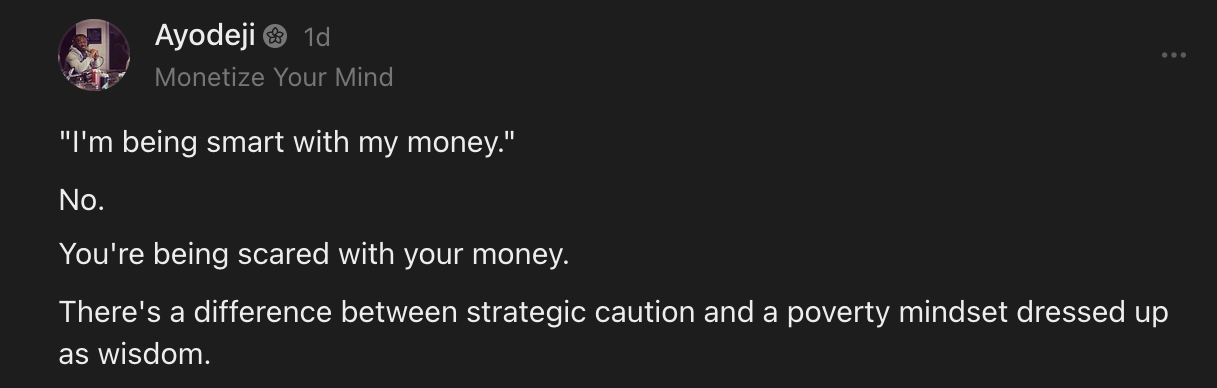
And that’s the real point: Every skill I’ve invested in, I’ve used over and over. I’m now in a position where, even if I lost everything, I’d have a way to dig myself out—because the skills come with me. That’s what separates a fragile position from a durable one. It’s not how big your paycheck is; it’s what you can do on your own.
Here’s why this matters more than ever. AI is reshaping entire industries. Companies are laying off people who assumed they were untouchable. The ground keeps shifting. In that kind of economy, the people who thrive aren’t the ones with the biggest salaries—they’re the ones with skills they can carry anywhere, who keep learning as the world changes.
The HENRY feels safe because the paycheck is big. But safety doesn’t come from the paycheck. It comes from being the kind of person who can always earn the next one.
Not rich yet? Start by shifting your mindset
Let’s bring it back to the original question: What do you think money is for?
Not for buying stuff. Not for credit and consumption.
Money is a vehicle to help you earn more. And the smartest place to put it is the one asset that can never be laid off, outsourced, or taken from you:
Yourself.
Shifting how you think about money is the difference between being the turkey and being the one who saw Thanksgiving coming.
So pick one skill worth building. Make one investment in your own capabilities. That’s how the climb begins and unlike the size of your paycheck, it’s entirely in your hands.