
In order to get what you want, you must figure out something difficult yet crucial—your priorities in life.
Because, no matter who you are, you don’t get to do everything you want. There’s simply not enough time.
And if you want to reach your goals and achieve your purpose faster, it’s wise to be decisive.
So before I share how to figure out your priorities in life, let’s dig into the mindset that will help you master the art of knowing what you want.
Spoiler: Not making a move is still a move
Indecision isn’t a neutral state.
Most people don’t make decisions because they trick themselves into thinking that doing nothing means they stay in the same place (which isn’t true).
Let me explain by taking a look at some real factors you have to contend with when it comes to going after goals.
Consider your age
I remember the first time I heard this. It shocked me, but it’s true.
When you hear the phrase middle-aged, what age do you usually think of? Maybe 50?
In reality, according to the actual lifespan data in the U.S., you’re at the halfway point of your life at age 38 if you’re a man and 40 if you’re a woman.
Regardless of age, you have to start where you are, but it IS true that some things get more difficult as you age: You don’t have as much energy as you used to, your mind may not be as sharp as it once was, and you probably can’t work as much as you used to.
Which is fine if your priorities in life aren’t about work anymore and you’re focused on enjoyment instead.
The inertia is real
The longer you wait to make changes in your life, the more resistance you develop to changing because you start telling yourself a story. “I didn’t change in the past, which means I can’t change now, so I might as well do nothing.”
It’s a negative feedback loop, and the longer it loops, the more difficult it is to get out of.
Simon Bowen has something called the futures model that explains this clearly. If you look at the image, there are two trajectories you can go on. Notice how, as time goes on, the gap becomes more difficult to close from red to green?
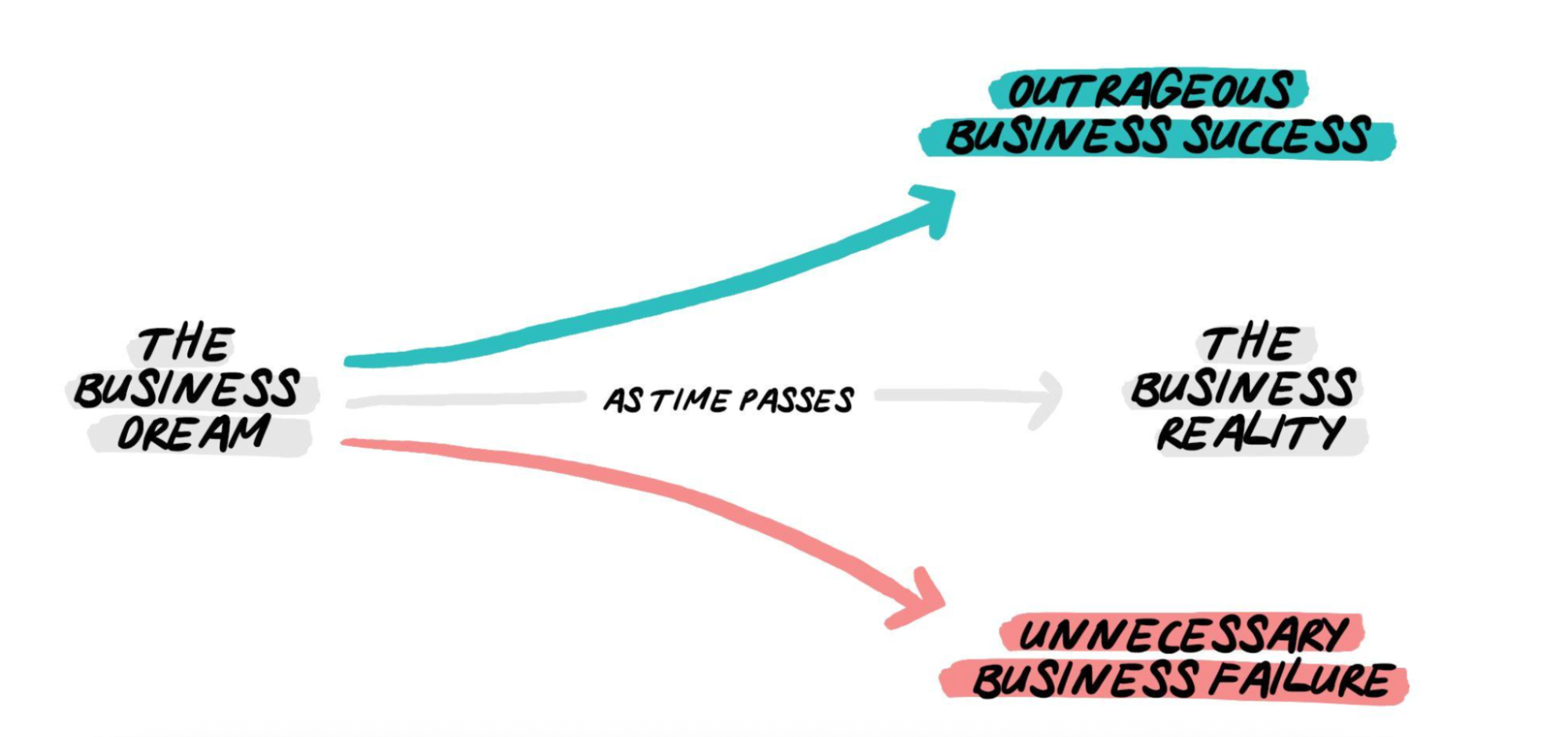
Simon Bowen’s “Futures Model”
You can apply this same thinking to pretty much any area of life. As time passes, it becomes more difficult to “jump lines.”
Difficult but not impossible. You can decide to break the loop, bridge the gap, and figure out what matters most so you can get what you want.
Don't wait to become your best self.
Gain real confidence, build your resume, and get paid.
It’s possible to break the loop
In the book “The Courage to Be Disliked,” the general theme can be summed up this way: You are under no obligation to live as you did in the past.
It’s based on the psychology theory of Dr. Alfred Adler, whose ideas often ran counter to what’s normally said in the field.
Essentially, he says there is no causal relationship between the past and the present. Rather, you are only experiencing it that way, and you’re deciding to stay the same because your goal is to stay the same instead of facing the uncertainty required to change.
Example: Your present goal is to stay stuck in a job you hate, so you manufacture a state of procrastination in searching for a new job, so you can avoid the rejection you’ll face by trying to reach for a job you feel unqualified for.
All of those negative loops I mentioned in the previous section? Per Adler’s theory, they are psychological illusions that feel like realities.
The spell of inertia can be broken at any time by deciding to change right now.
You can decide to be happy right now. You can decide you’re a motivated person right now. You can decide you’re a winner right now.
Instead of looking at the past, Adler says to ask a simple question:
What now?
This is why priorities matter. You can decide that your present goal is landing the job of your dreams, and have it take precedence over the goal of avoiding rejection.
Now that you understand that it’s possible to get what you want, let’s go through the process of figuring out what’s most important to you.
There’s no perfect playbook for this, but there are some mental models, heuristics, ideas, and strategies I picked up along the way that can be useful. Let’s get into it.
Warren Buffett’s 5/25 Rule
The “5/25 rule” is a strategy designed to help you eliminate distractions and figure out your priorities when it comes to your career trajectory.
- Brainstorm: Write down the top 25 goals you want to achieve in your career (or life).
- Make your picks: Circle the five most important goals.
- Cut-off choice: Review the remaining 20 goals. Label this the “Avoid-At-All-Cost” list.
- Ruthless Focus: Devote all your time, energy, and resources to the top five. Do not spend time on the remaining 20.
The theory is based on the idea that you only get so many runs, so many major career arcs in your life for things you want to accomplish.
I can attest to this. I spent ages 25 to 30 focused on becoming a full-time writer, which was one of my highest goals in life, and I did it.
From ages 30 to 35, I built an online business and made a great living doing what I love.
I’m 36 right now. And this arc will be focused on mastery of the craft, both in writing and in business. I’m going to keep doing what I’m doing, but try to become world-class at it.
If you want to get a bit more granular because you’re struggling to figure out what you want, this next set of questions can be helpful for you.
Find your strengths (the strategy I’ve used for a decade)
Years ago I built a strategy for discovering your natural talents—one I’ve written about in nearly all of my books, used to change my own life, and taught to thousands of readers since.
It starts with one contrarian premise: Forget passion.
Strength is the real starting point. When you find something you’re good at, practice it, and get better at it. Passion will show up as a byproduct.
The clues about what you should be doing are already scattered all over your life. Your upbringing, your offhand comments, the compliments you brush off. They’re all data.
I think deep down you probably already know the answer to these questions, but you can also take assessments like CliftonStrengths to help narrow it down. I took the assessment a decade ago. It told me to read, write, and find a career that rewarded me for ideas and thinking (over structure and organization). I already knew I wanted to be a writer. The test was just confirmation and permission for me to do what I already wanted to do. I didn’t actually do it, but this exercise reveals the power of forcing yourself to articulate what you want. I was in a business mastermind that focused on helping men, and the coach told us all to lock ourselves in a bathroom for 48 hours with nothing more than a pen, paper, and some food to eat. He told us to ask ourselves 3 sacred questions: Let’s walk through the exercises and expand on some of the questions. Getting clear on who you are and your ideal core identity is powerful because you can sort of method-act your way into becoming that person. I actually had a client once who trained college athletes and NFL draft prospects. Not physically, but mentally. He helped them define their core identity in a way that improved their performance on the field by getting them to see themselves, for example, as the type of athlete who performs in the clutch. It reminds me of another story. In 2003, at the lowest point of his career—public disgrace, sponsors gone, reputation in ashes, and failing team—Kobe Bryant invented a new person. He’d just watched “Kill Bill” (this is actually my second favorite movie of all time), where the deadliest assassin was codenamed Black Mamba. This is where his famous “mamba mentality” came from. When he stepped onto the court, he became the Mamba. Thanks to the identity change, he went on to win multiple championships. He didn’t discover the Mamba. He decided the Mamba. He authored an identity and lived into it until it became more real than the man he’d been. This is why the articulation of who you want to become is so powerful. Once you map out the parameters for this person, you can run your behavior through that lens and, at every stage and point, do what that person does in that specific situation. The above will be guided by your values. See, there are multiple tradeoffs in life, and saying yes to one thing often means saying no to another. I’m reminded of the 4 pillars of the good life that I learned from Tai Lopez, a personal development and business expert who changed my life a decade ago. The pillars are health, wealth, relationships, and happiness. If you optimize for money to the detriment of your health and relationships, you’ll be rich, but you’ll be out of shape, sick, and probably unhappy. You can overoptimize for health if you’re spending so much time in the gym that you don’t go out there and make money. Or, if you’re trying to use fitness to compensate for a lack of love in your life (getting in shape doesn’t fix your social skills). If you look at the four pillars, the two most important ones are your health and relationships because without either, life is pretty hollow. The regrets of the dying have very little to do with how much money you made. Actually, one of the regrets was working too hard (on things that didn’t matter). The others: I wish I’d had the courage to live a life true to myself, not the life others expected of me. I wish I’d had the courage to express my feelings. I wish I had stayed in touch with my friends. I wish that I had let myself be happier. So when you are thinking about the lifestyle you want to live, think about the things that actually matter by inverting from the typical regrets people have. I used to over-optimize for money to the point it was affecting my relationships. It took making money to realize it was hollow in the end, which helped me re-prioritize to focus on human connection. Take the time to evaluate your lifestyle goals wisely. One of my old business coaches told me to first schedule the non-negotiable things—exercise time, time with friends, hobbies. And then use the space that’s left on the calendar for the business stuff, so I built a business around my life instead of building my life around my business. This is a very short sample. You can also get into how you want to behave, show up in the world, and express yourself, too. The point is to take the time to sit down and articulate this. It’s ironic, one of the most important elements of our lives, human relationships, gets treated with so little time when it comes to discerning which ones we actually want to have. Related: This Is Why You Should Surround Yourself With Good People Maybe it’s because it seems transactional to have pre-defined parameters for the type of people you want to have in your life. Having a set of non-negotiables for a spouse seems unromantic and rigid compared to finding love serendipitously. But then again, you see people in cycles of relationships they don’t want to be in because they keep ignoring red flags because they’re infatuated. Or take friends. I was watching a clip of Alex Hormozi on Chris Williamson’s “Modern Freedom” podcast the other day, and he made a point that stuck with me: Outcomes don’t care about intentions. Two paths that lead to the same bad result are still the same bad result, no matter which one got you there. Here’s a milder version of the same idea: it doesn’t matter if you go broke because a business partner deliberately worked against you or because they gave you well-meaning but terrible advice—either way, you’re broke. Friendships work the same way. If someone in your life is making things worse for you, it doesn’t matter whether they mean to or not; the outcome is identical. A lot of people keep friends around because their intentions are good, but good intentions don’t erase the damage. It pays to define these parameters. These answers don’t need to be politically correct; they need to be what’s most important to you because it’s your life. There’s a neurological reason why writing this stuff down changes your life, and it’s not manifestation woo-woo. Your brain has a filter called the reticular activating system (RAS). At any given moment, you’re being hit with millions of bits of sensory information, and your conscious mind can only process a tiny sliver of it. The RAS decides which sliver. You’ve experienced this when you buy a new car, and suddenly you see that exact car everywhere. The cars were always there, but your filter just wasn’t set to notice them. Or someone says your name across a loud, crowded room, and it cuts straight through the noise. When you write down “I want a network of writers and creators in adjacent niches,” you’ve just flagged that as important. Now, when a potential collaborator shows up in your comments, your brain recognizes it instead of scrolling past. When you define the kind of spouse you want, you start noticing the presence—and absence—of those qualities on the second date instead of the second year. The opportunities were always in your environment, but you didn’t notice them because your filter had no instructions. Psychologists call the related effect priming. Exposure to a concept changes how you perceive and respond to everything after it. Articulate people prime themselves, on purpose, with their own words in a way that makes their desired reality clearer. Most people don’t get what they want because they haven’t actually taken the time to articulate it. Even though I just gave you a bunch of different ways to articulate what you want so you can make it become real, I can’t fix the choice paradox. The choice paradox is where you get stuck in a loop of never deciding because you want to keep your options open, often to avoid wasting time, which ends up wasting time and keeps you in the optionality loop. The word “decide” comes from the Latin decidere, which literally means “to cut off.” It shares the same root as homicide and suicide—caedere, to cut down or kill. A real decision requires killing the alternatives. That’s why so few people actually decide anything. They “choose” a path while secretly keeping the other doors cracked open, then wonder why they never make progress down any of them. If you haven’t cut something off, you haven’t decided. Take all of these exercises and do them. Spend time really thinking about them. Go wide, but then go narrow and go deep on the handful of things that actually matter. You’ll have to make a conscious decision to let some stuff go (dreams, lifestyles, even people), but it’ll be worth it because you’ll be left with something a lot of people don’t get: a vision for your life that you unapologetically realized and intentionally chose. . .Ask yourself these questions:
The art of articulation
Who am I?
What kind of life do I want to live?
This is not one-size-fits-all, but here’s an example from my life: I wake up without an alarm because my sleep is dialed in. I train four mornings a week, and my body shows it. I spend my best hours on my craft, and I’m done by mid-afternoon. I have a standing game/dinner/hangout night with friends I never cancel. I call my parents every Sunday. I read constantly, not to optimize anything, but because I love it. There’s an unplugged day every week where nobody can reach me, and nothing falls apart.What kind of companions would suit my desired life?
Why articulation actually works: Your RAS and priming
Why priorities in life matter so much