If you’re an introvert who’s curious about sales but dreads the thought of, you know, actually selling, this one’s for you.
The idea that extroverts are naturally better salespeople is one of the most persistent myths in professional life (and btw, it’s one of several things people get wrong about working in sales).
The research tells a different story. When organizational psychologist Adam Grant studied 340 outbound sales reps, he found the link between extroversion and sales performance was weak and inconsistent. His research found that extroverts didn’t come out on top, and that ambiverts (the people in the middle of the introvert-extrovert spectrum) actually outsold them.
A more recent study in the “Journal of Business Research” found that introversion can be “advantageous, given certain conditions.”
Yet, somehow we STILL can’t shake these stereotypes in sales:
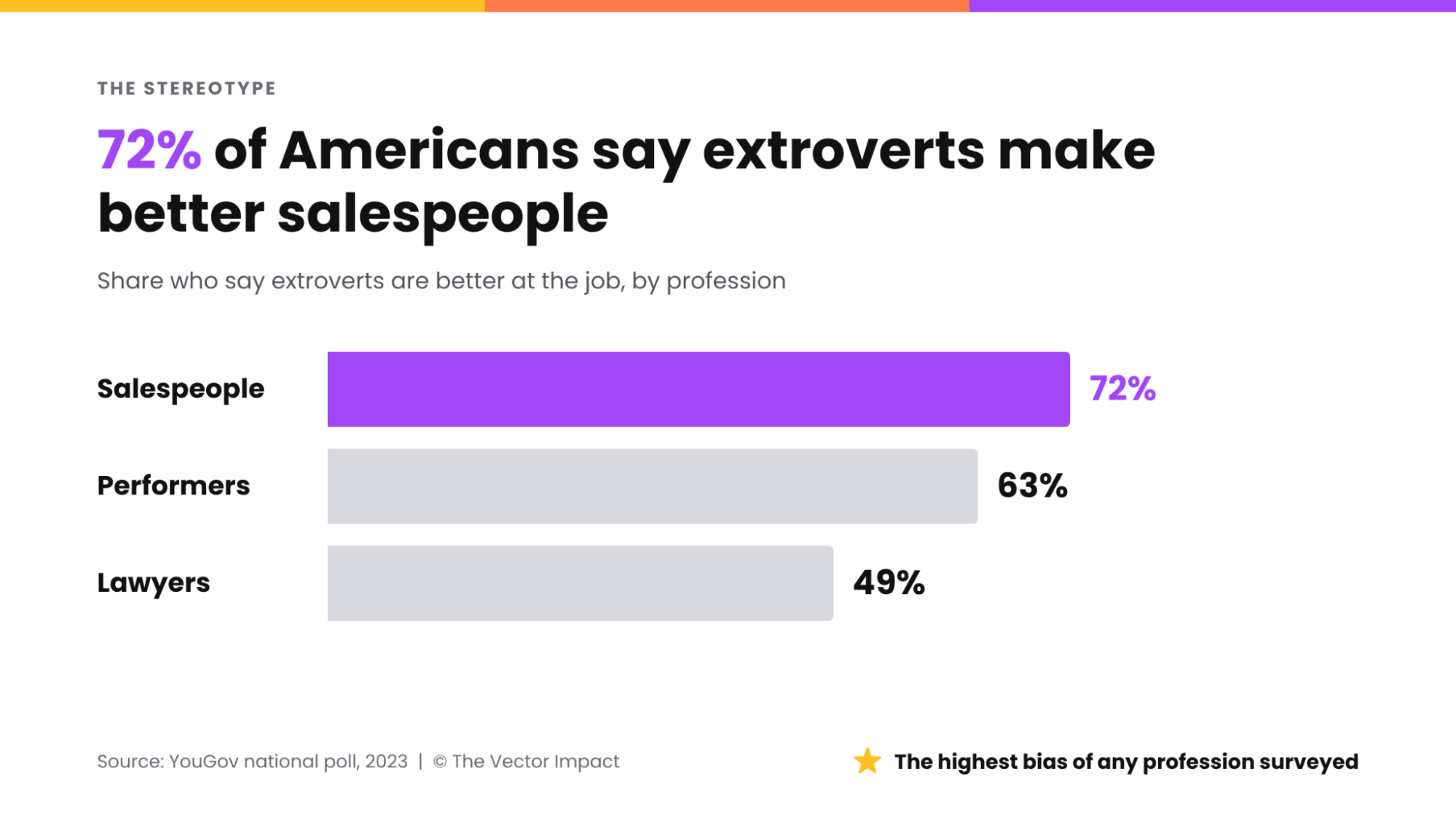
But now you know better.
If you’ve previously written off sales because of that misinformed public perception, you’re worried what other people will think, or you’re afraid you might fail, consider this your sign to reconsider. ✨
Plenty of self-identifying introverts have joined the Vector team over the years and gone on to succeed. (And so can you.)
Life is selling.
Whether you're pitching a client, nailing an interview, or talking your friends into Thai food, you're selling. Learn how at Vector.
5 Things introverts do exceptionally well in sales
My fellow introverts, you’ve probably heard “you’re so quiet” more times than you can count. I’m happy to report that the traits behind that comment are some of the most useful ones in sales. Here are five superpowers that give us introspective types an edge.
1. Listening instead of performing
Plenty of salespeople fall into the trap of dominating the conversation, filling every silence, and staying “on.” That can backfire. Adam Grant, the researcher behind the study above, suggests that extroverts may spend too much time pitching and too little listening, and that their enthusiasm can prompt customers to scrutinize the message and push back.
Gong’s analysis of 326,000 sales calls tells a similar story. Lost deals often featured long seller monologues, while won deals had more back-and-forth.
Introverts tend to be comfortable letting the customer talk. A customer who feels heard is a customer who trusts you.
⚡ Try this: When a customer finishes a thought, take a breath before you respond. That pause isn’t awkward. It’s you listening.
2. Asking better questions
More questions isn’t the goal. Gong found that won deals averaged 15 to 16 questions per call, while lost deals averaged about 20. What matters is whether your questions dig into what the customer actually cares about.
According to The Quota, research from organizational psychologist Murray Barrick found that 82% of top salespeople had extremely high curiosity levels. Introversion doesn’t automatically mean curiosity, but introverts’ deep-thinking tendencies often feed it.
⚡ Try this: Build your next question on the customer’s last answer instead of moving down a list.
3. Doing the homework
Many introverts would rather prepare than improvise. You have deep knowledge of the product, you anticipate objections, and you’ve thought through the conversation before it happens.
In a study of 91 sales reps, conscientious reps set goals and committed to them, which led to higher sales volume and better supervisor ratings. Extraversion wasn’t related to either outcome. That kind of readiness oozes confidence (and often makes the the sale).
⚡ Try this: Before your next presentation, write down the three objections you’re most likely to hear and how you’d answer each.
4. Building relationships, not just rapport
There’s a difference between being likable in the moment and being someone a customer actually trusts and returns to.
Introverts tend to invest in depth over breadth, which is a big asset in relationship-driven selling. In interviews with home buyers, researchers found that buyers read attentiveness as a sign that an agent cared, and that they felt better understood over repeated interactions.
⚡ Try this: After a sale, follow up with something specific you remember from your conversation.
5. Relating to the customer
Nearly 40% of Americans identify as introverts, and another 31% call themselves an equal mix. Only 22% identify as extroverts. That means roughly 7 in 10 of your potential customers see themselves as introverted or somewhere in the middle.
That doesn’t mean every customer wants a quiet pitch. It does mean a high-energy, close-at-all-costs playbook won’t land with a lot of people. An introvert who sells the way they’d want to be sold to, thoughtfully, with patience and real product knowledge, is often a better match for those customers.
⚡ Try this: Before you pitch, ask yourself how you’d want this explained to you, then adjust based on how the customer responds.
Sales is good for introverts, too
Remember that mix of curiosity and dread from the start of this post? That uneasy feeling is totally normal.
There’s no need to change your personality for sales or anything else. You already bring the listening, the curiosity, the preparation, and the depth.
So the question is, what can sales do for YOU?
Of course, there’s the practical benefits like your income and resume-building. Vector reps enjoy flexibility and autonomy. But there’s a lot more under the surface, and I’d argue the biggest benefit of all is…
The chance to stretch yourself.
As adults, we only gain new skills when we challenge ourselves in new ways, and sales is one of the most practical places to do it.
We hear again and again from folks who work with us that their sales experience transformed their communication skills, and not just during presentations. They notice it in school, in relationships, and job interviews. Putting yourself out there and learning to talk to anyone takes practice, but every conversation makes the next one easier.
In the end, your personal sales success has much more to do with attitude, resilience, and discipline than with whether you lean introverted or extroverted.
You just need a place to practice.
.
.
If you’ve been on the fence, there’s no time like the present to find out what you’re capable of ➜ Request an interview today.