


My big breakthrough about personal branding came when I was designing the website for my first business.
I was building a fiction editing business (which is still going today), and was trying to decide which colors to use.
Should I go with an urgent red? A professional green? A sunny orange?
After hemming and hawing over it, I realized I could just choose my favorite colors. I went with a combination of my favorite blues, and still use those colors to this day.
A personal brand is a lot more than brand colors (more on that later), but the realization I had here was important nonetheless.
I was working on a brand that was mine. It was a representation of me, as a worker and an editor. Why shouldn’t it reflect me in every way possible?
Fast forward ten years, and now I have two more businesses under my name, plus my personal website for creative projects.
Altogether, these businesses and their various websites, social media profiles, and general vibes make up my overall personal brand—the brand that I rely on to live a happy and comfortable lifestyle as a freelancer.
For a long time, I resisted the idea of building a personal brand. Now, I see my personal brand as the main reason why I earn a decent living as an entrepreneur, and why I enjoy my work so much.
This guide contains all of my best advice and resources for building your own brand, with some prompts and exercises to help you get started.
What is a personal brand?
It’s the unique combination of skills, experiences, and personality that you present to the world professionally. Think of your personal brand as your professional reputation—the impression people have of you and what you stand for.
Unlike a company brand, which represents an organization, your personal brand follows you wherever you go. It exists whether you actively build it or not, showing up in your LinkedIn profile, your portfolio, the way you communicate, and how former colleagues describe you to others.
People use personal brands for different reasons depending on where they are in their careers. Freelancers (like me) rely on personal brands to attract clients and stand out in competitive markets. Entrepreneurs build personal brands to establish credibility before their companies are well-known. Even traditional employees benefit from strong personal brands when networking, changing jobs, or positioning themselves for promotions.
Your personal brand encompasses everything from your professional expertise to your communication style to the values you demonstrate in your work. It’s what makes you memorable and helps people understand what they can expect when they work with you.
The strongest personal brands feel authentic rather than manufactured. They reflect who you actually are, not who you think you should be.
Who needs a personal brand in 2026?
Anyone who plans on working for themselves, as a freelancer or entrepreneur, needs a personal brand. For independent workers, a strong and robust personal brand can mean the difference between lots of high-paying work and a totally dry client pipeline.
In today’s day and age, however, a personal brand can be a valuable asset for someone who works a more traditional, long-term job.
The modern worker is far more likely to move from one job to another, compared to older generations that would stay with a single company for decades. Having a consistent personal brand comes in handy when you are applying for new jobs—in many ways, it is like a living resume, one that captures a much fuller and richer picture of you as a potential candidate at a new job.
Bear in mind that your personal brand also greatly impacts how you show up online. When you apply for a job (or meet someone new), you should expect that your name is going to be run through Google, ChatGPT, and social media channels.
These tools scrape the web to generate a summary of who you are. Without a deliberate personal brand, that summary might be inaccurate, incomplete, or just confusing. A strong personal brand ensures that whether someone finds you through traditional search or AI, they get a clear, consistent picture of your professional identity.
When you have a personal brand, however, you get to control what shows up when they search.
For example, look at what Google has to say about me when I type my name into its AI mode:
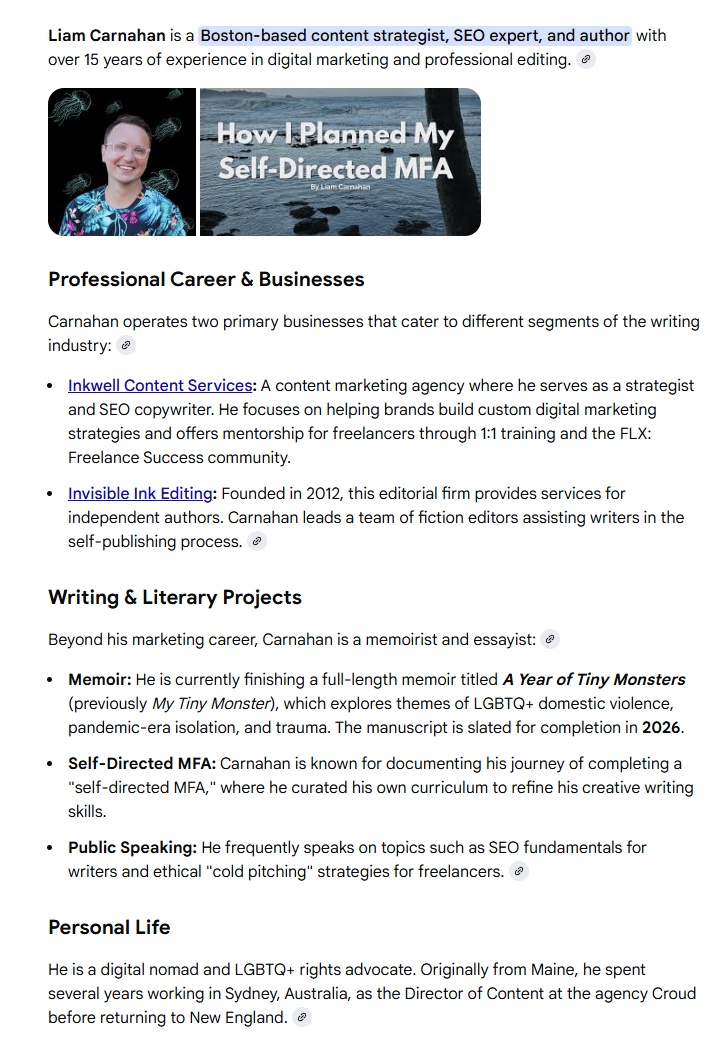
This is a great summary in my opinion—because I mostly wrote it! AI has used snippets from my websites, my social media, and other places where I’ve showed up online to draw a very flattering picture of me—one I’d be happy to show to a hiring manager, new client, or potential colleague.
Why personal branding sometimes feels uncomfortable
Before we get into how to build a personal brand, a warning: This process can sometimes feel frustrating, and even a little icky.
There’s a real tension in merging your personal identity with your professional one. It can feel like you’re turning yourself into a product, packaging your personality for consumption. That discomfort is valid.
The good news is that personal branding doesn’t have to feel inauthentic or gross. When done right, it’s simply a way of presenting your genuine self consistently across different platforms and contexts.
If you’re struggling with this tension, check out my full guide on self-promotion without the ick, which provides concrete strategies for navigating these waters.
What goes into a good personal brand?
We’ve defined what a personal brand is, but it can be hard to picture it, because it’s not necessarily any one thing. A personal brand is a constellation of different factors, some of which you can see and experience, and others that are intangible but just as important.
Your professional image
This is the most visible part of your personal brand. It includes your resume, portfolio, LinkedIn profile, and any other professional materials that showcase your work and experience.
Strong professional images are clear, up-to-date, and easy to navigate. They highlight your best work without overwhelming viewers with every project you’ve ever touched.
For more resources on building these elements, check out these articles:


Your ethics and beliefs
What you stand for matters as much as what you do. Your personal brand should reflect your professional values and the causes you care about.
This doesn’t mean broadcasting every political opinion or personal belief, but instead being consistent about the principles that guide your work—whether that’s sustainability, accessibility, transparency, or something else entirely.
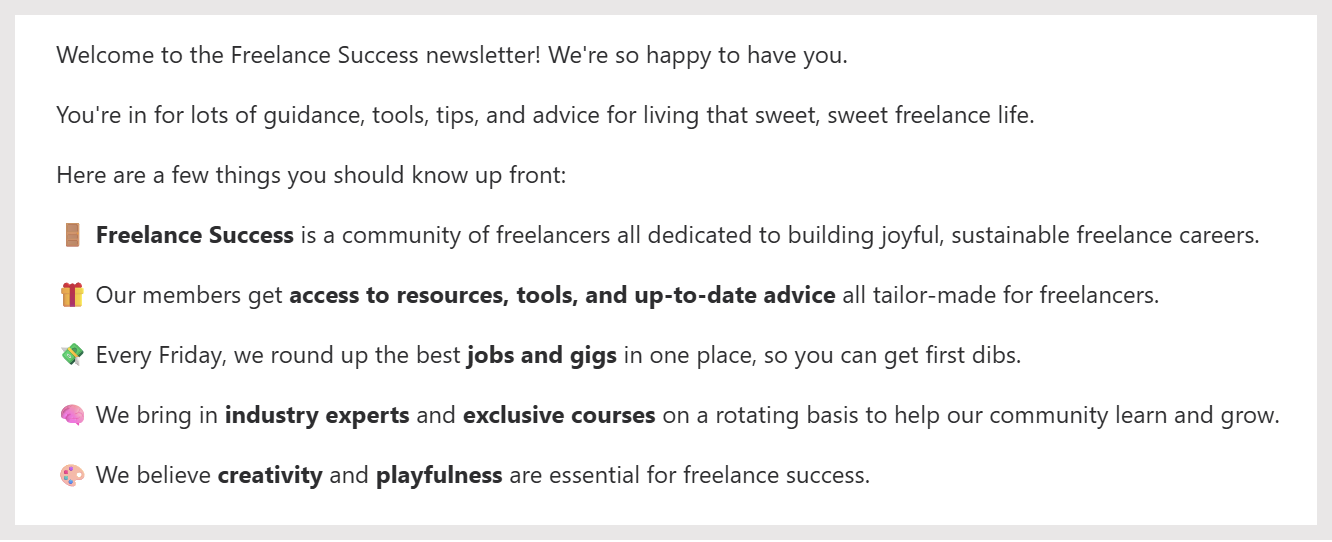
For example, I list out my personal beliefs and ethics in my email marketing streams for one of my websites (JoinFreelanceSuccess.com), so that people are very clear where I stand when they start engaging with my personal brand:
Your personality
Generic professional personas don’t stick in people’s minds. Your personality—the words you use, your unique quirks, humor, and perspective —that’s what makes you memorable.
Are you the person who always asks the unexpected question in meetings? Do you approach problems with optimism or healthy skepticism? These traits become part of your brand when you let them show consistently.
Your voice and style
How you communicate says as much about you as what you communicate. Your voice might be casual and conversational, formal and precise, or somewhere in between.
This extends beyond writing to how you present ideas in meetings, structure your emails, and interact on social media. Your personal style often comes through in the small details of everyday communication. For example, funny email signatures can showcase your personality while making your messages more memorable. Consistency in voice helps people recognize your work even before they see your name attached.
Physical branding
Now we get to the visual elements that people often think of first when they consider personal branding. Colors, fonts, logos, and design choices—these matter, but they’re not the foundation of your personal brand.
Choose visual elements that feel authentic to you rather than chasing trends. If you love bold colors, use them. If minimalist design speaks to you, embrace that. Your visual brand should support your personality, not overshadow it.
Your approach and systems
How you work is part of your brand too. Do you have a specific methodology you follow? A unique way of organizing projects or solving problems?
These systems and approaches become recognizable patterns that clients and colleagues associate with you. They’re proof points that demonstrate how you think and operate.
How to build your personal brand
Building a personal brand doesn’t require a massive portfolio or years of experience. You can start right now, wherever you are in your career—even if you’re just starting out.
Here’s a simple process you can follow to begin.
Step 1: Audit where you’re at now
These days, it’s easy to start building a personal brand without actually meaning to. You likely already have some presence online—and like it or not, that’s currently the foundation of your personal brand. It’s best to know what’s out there, so you can know what to adjust going forward.
Search for your own name on Google and a few AI tools like ChatGPT or Perplexity. Take notes about what shows up. Is the tool able to distinguish you from other people with similar names? Are there websites or mentions that you wish were or were not being featured?
Check your existing professional profiles—LinkedIn, portfolio sites, social media accounts you use professionally. What impression do they give? Are they consistent with each other, or does each platform tell a different story about who you are?
Make a list of what’s missing or needs to be added. This becomes your roadmap for building your personal brand.
Step 2: Answer the big questions
Now dig deeper into what makes you unique. Set aside 30-60 minutes to work through these questions:
2. What professional values are non-negotiable for you? (Think about times you’ve walked away from opportunities that didn’t align with your principles.) 3. What do people consistently come to you for help with? 4. What aspects of your work energize you versus drain you? 5. If you could only be known for one skill or quality, what would you choose? 6. What makes your approach to your work different from others in your field? 7. What topics could you talk about for hours without getting bored? 8. What do you want to be doing professionally in five years, and how does that shape how you present yourself now?1. What three words would former colleagues or clients (or teachers and friends) use to describe working with you?
Don’t rush through these. Your answers become the foundation for everything else you build.
Step 3: Craft your personal brand statement
A personal brand statement distills everything you’ve identified about your brand into a clear, concise description of who you are professionally and what you offer.
This isn’t a tagline or a mission statement. It’s a one or two-sentence description that captures your expertise, your approach, and what makes you different.
For concrete examples, check out our article on personal brand statements.
Step 4: Study personal brands you admire
Look for people whose personal brands resonate with you. They don’t need to be in your exact field—in fact, looking outside your industry often provides the most interesting insights.
What patterns do you notice across their platforms? How do they talk about their work? What makes their brand feel cohesive? Take notes on specific elements that appeal to you, but resist the urge to copy. You’re looking for inspiration, not a template.
Here are a bunch of examples to get you started (and show you what to avoid):


Step 5: Build your presence
Now it’s time to create something tangible that represents your personal brand.
This might be a personal website, a blog, a portfolio site, an updated LinkedIn profile, or a combination of platforms. The key is choosing channels where your target audience actually spends time. If you end up using a few of them, a link in bio page is an easy way to tie everything together, so people can reach your site, socials, and portfolio from one shareable link.
A website gives you the most control and flexibility. You decide the layout, the content, the imagery—everything reflects your choices. Even a simple one-page site can effectively showcase your work and personality.
Social media platforms offer different advantages. LinkedIn reaches professional networks. Instagram works well for visual portfolios. Bluesky or Substack are great for writers and educators. Choose based on where your ideal clients, employers, or collaborators are looking.
Start small and build consistently. One well-maintained platform beats five neglected profiles. Focus on quality over quantity, and eventually, your personal brand will start to take shape.
Here are more guides to check out as you go through this process:




Step 6: Let your brand evolve
Your personal brand shouldn’t be static. As you gain experience, develop new skills, and clarify your professional direction, your brand should evolve too.
Plan to refresh your materials annually. Update your portfolio with recent work, revise your bio to reflect your current focus, and adjust your messaging as needed.
Bigger rebrands might happen every few years—when you pivot to a new industry, develop a new area of expertise, or fundamentally shift your professional identity. These changes are normal and healthy. Your brand should grow with you, not constrain you.
Building a personal brand takes time, and it won’t happen overnight. But every step you take—updating your LinkedIn, clarifying your professional values, or just being more intentional about how you present yourself online—adds up. The most important thing is to start. Your personal brand already exists in some form, whether you’ve been actively shaping it or not. Now you have the tools to take control of it, make it authentically yours, and use it to create opportunities you actually want. So pick one step from this guide and get started today.





Ava Pose Notes says:
A practical way to make personal-brand photos look less stiff is to walk into the shoot with a shortlist of 5 to 10 pose references grouped by use case: headshot, About page, newsletter banner, and social profile. That usually gives better hand placement and body angles than improvising on set.
Anna Schmohe says:
Planning out photo use case is a great tip! I can see how that would help the photographer better capture the brand/personality you’re trying to convey.
Sikkim Lottery says:
I loved the section on storytelling and how it can amplify your personal brand. Thank you for sharing these actionable tips!
Anna Schmohe says:
Glad it was helpful!
Frida Kline says:
I appreciate you sharing this blog post. Thanks Again. Cool.
Anna Schmohe says:
Glad it was helpful! 🙂
Minecraft Bedrock apk says:
Can’t wait to implement these strategies and see the impact it has on my online presence! Thank you for sharing.
Anna Schmohe says:
Glad it was helpful and good luck!
seobot says:
thanks very good web site
Anna Schmohe says:
Visit again soon! 😉
In999 Login says:
The tips on authenticity really resonated with me. Thank you for sharing!
Anna Schmohe says:
Glad to hear it!