Being “qualified” isn’t impressive anymore.
Not in 2026.
Not when AI can write code, build decks, analyze spreadsheets, and generate strategy faster than your entire internship cohort combined.
For years, the formula was simple:
Get the credentials.
Gain experience.
Work hard.
Now? That’s table stakes.
Companies are leaner. Budgets are tighter. Software is replacing entire layers of knowledge work. Hiring managers are looking at every open role with a much sharper lens.
They’re not asking, “Is this person capable?”
They’re asking something much more specific.
And if you can’t answer it clearly, confidently, and with proof… someone else will.
The Job Market Doesn’t Care About Effort. It Cares About Impact.
I can’t recall a time where the job market was in more flux.
I’m a business coach and marketing consultant that works with career coaches, so I spend a lot of time understanding the market and the participants in it.
Spend five minutes on LinkedIn and you’ll feel it:
- Job seekers are exhausted and nothing they do turns into a role
- Recruiters are swamped with thousands of applications
- There’s frustration and anxiety coming from both sides
Here’s what’s happening:
When the economy takes a turn for the worse, companies get leaner. They are more careful about taking on new hires because they don’t want to waste money. And in these times, they are looking at alternatives.
AI stands out here.
The other day, I saw a Google software engineer say they were dealing with a problem that their entire department of engineers spent a year trying to solve.
Claude Code—an AI tool that understands entire codebases and can write, test, and iterate on code without human supervision—solved it in one day. In one day.
Most people assumed AI was going to come for “low leverage” tasks first, but it actually came for knowledge work.
With the advent of new technologies and uncertain economic times, companies are laser-focused on…
The Only Question That Matters: “Why Should We Hire You?”
Every hiring manager (whether they say it out loud or not) is thinking:
Why should we hire you instead of automating this, outsourcing it, or leaving the role unfilled?
If any of these answers come to mind, you’re done for:
- “I’m a hard worker”
- “I’m qualified”
- “I have years of experience”
Hate to break it to you, but they don’t care.
They’re looking at you like an investor looks at a stock: trying to decide whether or not you’re a good return on their capital.
Your answers should be much more in line with:
- I’ll help your company make more money
- I’ll help your company save money
- I’ll help your company save time
You need to explain the business impact of your work.
This is the skill you must master in 2026 and beyond. If you can’t clearly answer “Why should we hire you?” (with evidence) you will struggle to land a job. Or keep one.
A real example: How proving ROI changes your career
One of my clients, Kai, is a senior UX designer who teaches something called “data informed design.”
He shows designers how to use data to explain why their design decisions are worth implementing. This is important because companies are shredding designers left and right (not recognizing their real value).
Companies care about sales, engineering, product—what they believe directly impacts revenue.
Design is often viewed as an afterthought, as in “Sure, an interface needs to be designed, but it’s not a huge deal how it looks.”
Designers feel differently. UX designers create a user experience. The placement and size of a button, the contrast of the text, the spacing between form fields—all of these things affect what a user will do on a site.
And while a lot of designers know this intuitively, they can’t explain it or don’t have the data to back it up.
My client shows them how to do this. Here’s his story:
Kai conducted user research and discovered customers were abandoning the process because shipping costs appeared too late—surprising them at the final step. He moved the shipping estimate earlier in the flow. Completion jumped to 60%. That’s not: “I redesigned the checkout flow.” That’s: “Checkout completion increased 20 percentage points because I identified abandonment friction and removed it.” That’s how you answer “Why should we hire you?”At one company, checkout completion was stuck at 40%.
Kai actually learned this skill out of frustration.
See, he was about to quit being a designer. After he was first hired, he was involved in the decision making, but after a while he started getting excused early and eventually excluded from meetings with the execs and product team.
He said his work started to feel meaningless. Like he wasn’t making any impact, which is why he got into design in the first place. He didn’t quit, though.
Instead, he tried to figure out what the heck was going on. He started reaching out to different PMs and execs to ask questions.
They all said the same thing:
“We don’t know what design actually does.”
So Kai asked them what they cared about, which was: Numbers. Metrics. Proof. So Kai would focus on one of these metrics and find a design decision that influenced it.
He began communicating these insights at work and started getting invited to meetings again. He documented his ideas online, which led to landing a new job from someone who discovered him.
Sharing those insights also helped him become a sought-after consultant, and with a little bit of help from yours truly, he built a side hustle with a six-figure run rate (while still working at his six-figure job).
This is the power of proving the ROI of your work and becoming a strategic partner, instead of someone who just works for a company.
Related:




Think like an intrapreneur (even if you’re entry-level)
There’s a difference between implementing a hard skill and being a strategist who partners with the business to help steer the company in the right direction.
When you combine business strategy with technical execution, you’re now an asset instead of an employee.
Thinking strategically and thinking like a business owner don’t come naturally to most people, which is why they don’t run businesses to begin with, but you can learn the intrapreneur mindset.
It’s as simple as figuring out:
- What the company wants to accomplish
- The metrics/conditions they track to see how well its working
- How what you do contributes to all of the above
The good news? Your skills DO contribute to business impact already. You just need to learn how to highlight them and create a narrative.
Here’s a cool example I found on LinkedIn that illustrates this:
So many job seekers are struggling because they think:
“I just create data models”
“I just manage projects”
“I just create social media content”
No, you do so much more. Give yourself credit and claim authority.
Here’s how to start thinking about your impact, collecting past wins and case studies, and tying them to business outcomes.
Start by stealing from the top
Find out what your company (or industry) cares about at the highest level. Revenue? Growth? Reducing costs? Risk mitigation? Patient outcomes? What keeps leadership up at night?
This is your starting point.
Now work backwards.
Ask yourself what mid-level goal connects to that outcome?
Usually it’s something like acquisition, retention, efficiency, compliance, or reducing churn. These are part of the middle layer.
Then ask yourself what you actually did that moved that needle?
This is where most people stop.
They say “I ran reports” or “I managed accounts” or “I processed claims.” That’s the what.
You need the “SO WHAT?”
Take one project you’re proud of. Write down the task in plain English. Then ask “So what?” to yourself three times.
Don’t have hard numbers? That’s fine. Stop thinking about metrics and start thinking about consequences.
- What do you prevent from happening?
- What patterns do you spot that others miss?
- What goes wrong when someone without your expertise makes the call?
Quit minimizing your skill set and what you’re capable of.
However average it feels to you—the pattern recognition, that judgment call you make without thinking—that’s specialized expertise. You forgot it was valuable because it became automatic.
Talk to people outside of your immediate role. Ask leaders and cross-functional partners what metrics they care about. Ask how they measure success.
Don’t have a job right now? Even better. You have nothing to lose. Reach out to complete strangers.
Stop describing what you do.
Start describing what changes because of you. What you prevent. What you protect. What falls apart without you in the room.
Now you have the philosophy and the strategy. Let’s talk implementation.
Build skills that translate to real results.
Sales, autonomy, time management. Your future self will thank you.
How to scream “I create results”
We’ll look at three areas: your LinkedIn, your resume, and your interviews.
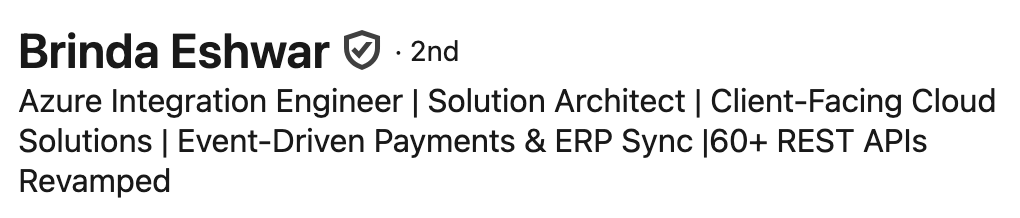
Your headline is prime real estate. Don’t waste it on your job title. Recruiters search for outcomes and skills, so that needs to be front and center.
LinkedIn’s algorithm scans for specific keywords pulled directly from job descriptions. If you’re using fluffy buzzwords like “results-driven” and “strategic thinker,” you’re invisible.
Here’s the fix. Pull 15+ job descriptions for roles you want. Paste them into ChatGPT and ask for the top 15 keywords and skills. Then weave those exact terms into your headline, About section, and skills.
Structure your headline like this: [Job Title] | [Specific Skills] | [Value You Provide]
Example: Financial Analyst | FP&A, Forecasting, Power BI | Built models that improved forecast accuracy to 98%
Here’s another solid example I found out in the wild on LinkedIn:
Your About section needs to read like a sales page.
Open with the problem you solve. Skip the origin story and education details. Then show proof you’ve solved it before. End with what you’re looking for.
Here’s what that looks like in practice:
Companies bring me in when their data is a mess and nobody trusts the numbers. I’ve spent 8 years turning chaotic reporting systems into dashboards executives actually use. At my last company, I rebuilt the forecasting model from scratch after years of 15%+ variance. Got it down to 2%. Finance started making decisions in days instead of weeks. I take fragmented data, find what’s actually driving the business, and build reporting that people trust enough to act on. A few highlights: Looking for a senior analytics role where I can fix what’s broken and build what’s missing. Open to connecting: johnsmith@gmail.comAbout section example:
Notice what’s not in there: “passionate self-starter,” “leveraging synergies,” or three paragraphs about where they went to school. Just the problem, the proof, and the ask.
Now, let’s move on to your experience.
People often list duties like a job description, but your LinkedIn profile should start conversations.
Instead of bullet points, write mini-stories for each role.
- What was broken?
- What did you do?
- What changed?
One last thing: Put your email in your About section. Not just in the Contact Info section. Recruiters won’t always click through, and if they can’t reach you easily, they move on. Use a dedicated Gmail if you’re worried about spam. The upside outweighs the risk.
Make it easy for recruiters to find you by speaking their search language.
Related:



Resume
Most people were taught to document every responsibility since day one of their career. This creates a dense document that doesn’t showcase impact.
Companies hire for solutions, so tailor your resume to the solutions you’ve provided in the past.
Start an “achievement bank.” This is a running document where you dump every win. Client saved. Error caught. Process improved. Revenue protected.
Don’t filter—just collect.
Think through these questions for each role:
- How many?
- How much?
- How fast?
- How often?
- How big?
- What changed?
How many client implementations have you led? How many transactions did you handle monthly? Did you reduce post-launch issues? By what percent? Did you improve delivery metrics? Which tools did you use? Did you build reports or dashboards? What did they track?
Most people can’t answer these questions off the top of their head. That’s the problem. The details that make your experience stand out are buried in your memory. Dig them out now, before you’re scrambling to apply.
Every bullet needs to be impact-oriented. Use power verbs and numbers.
After: “Spearheaded 3 product launches reaching 1M+ users” Before: “Designed new checkout flow” After: “Increased conversion by 34% by identifying users abandoned at shipping costs”Before: “Responsible for team projects”
If you don’t have a hard number, use scale.
“Supported a team of 12.” “Processed $5M in transactions monthly.”“Handled 200+ accounts.”
If you don’t have scale, focus on behavior change.
“Reduced onboarding time by 80%.” “Cut support tickets in half after redesigning the help center.”“Checkout completion went from 40% to 60%.”
If you don’t have behavior change, use consequences.
“Flagged vendor issue that prevented two-week production delay.”“Identified compliance gap before annual audit.”
When you apply, pull from your achievement bank and tailor. Match your wins to what the job posting says they care about. Only include what aligns with their priorities. The job market rewards clarity and relevance.
Interviews
Interviews are just a live test of whether you can answer “Why should we hire you?” under pressure.
Most people lose interviews because they can’t clearly communicate how they think and deliver results.
If you blank under pressure, lose people with long-winded answers, or struggle to show your strengths without oversharing, you need a system.
When you have an inventory of accomplishments, you don’t need to articulate value on the fly.
Create 5-7 high-impact stories you can reuse across questions. Think of stories that show meaningful change from start to finish, involve stakes or urgency, demonstrate both soft and hard skills, and include tangible results. These five stories can cover 90% of behavioral questions.
Stop using the STAR method. It’s too long and you’ll lose people.
Structure every answer using Challenge-Action-Impact (CAI).
Action: What specifically did YOU do? (30 seconds) Impact: What was the measurable result? (15 seconds)Challenge: What was broken or at risk? (15 seconds)
When an interviewer asks about a particular aspect of your role, a weak answer looks like:
“I managed email campaigns.”
A strong answer (using CAI) would be:
“Email engagement had dropped 15% over two quarters. I A/B tested subject lines and optimized send times based on open rate data. Engagement increased 22%, generating $120K in additional pipeline.”
Once you’ve covered those three components, stop talking. Most people ramble because they don’t have a structure. CAI is your structure.
Now flip the script. Ask questions like a consultant would:
- “What’s the biggest bottleneck the team is dealing with right now?”
- “If this role is successful in 12 months, what does that look like?”
- “What’s been tried before that didn’t work?”
This shows you think like someone who owns outcomes. It also gives you ammunition for your follow-up.
Believe it or not, your thank you note can make or break a close decision.
When you send one, reference a specific challenge they mentioned. Then briefly outline how you’d approach solving it. One paragraph max. Just enough to show you were listening and you’re already thinking about their business.
Strategic candidates are memorable.
You can’t fake strategic partnership
Strategic partners show up with ideas, speak the language of business outcomes, and position themselves as solutions to problems.
That mindset changes how you write your LinkedIn, how you frame your resume, and how you walk into an interview.
There aren’t any shortcuts.
You have to actually collect the evidence.
Start your achievement bank today. Right now. Before you need it.
Every time you catch an error, save a client, hit a deadline, improve a process, or get a compliment from a stakeholder, write it down. Date it. Add whatever numbers or context you can remember.
Most people forget 90% of their wins within six months. Don’t be most people.
And talk to others. Constantly.
If you’re employed, talk to folks outside your department. Ask product managers, finance leads, and execs what metrics they care about. Ask how they measure success. You’ll start to see patterns that help you translate your work into their language.
If you’re not employed, you have nothing to lose. Reach out to complete strangers. That’s how you learn to speak the language of your field.
In this market, clearly articulating why you matter beats credentials every time.
That’s how you become someone they can’t afford to lose.