
If you want to make more sales and give people a better buying experience, take a consultative approach.
In a consultative sale, you’re not trying to pressure anyone into buying. Your goal is to help the person you’re talking to make the best decision for them—even if that decision is no.
It’s all about being on the same team as the person you’re selling to. It’s building a relationship and actively listening. Someone watching a good consultative sale might even describe it like a Jedi mind trick. But truthfully, it’s a lot more straightforward.
It works because people don’t like being sold to, but they do like buying.
I’m going to walk you through four ways to show up as a salesperson, a framework from sales trainer Vanessa Horn, and why the consultative approach beats the other three. But first, let’s talk about the two traits behind them all.
These characteristics show up on every sales call
1. Authority
Authority is your expertise. You show it in three ways:
- Diagnosing. You’re able and willing to figure out what the person is dealing with.
- Recommending. Your advice fits the problem they actually have.
- Leading. You structure the call or presentation so they know how it will go and what’s expected.
Every presentation has a rhythm. If you don’t set the structure, the other person ends up leading the conversation instead of you.
You come across as an authority when your advice is welcome and you’re seen as knowledgeable. Think of a doctor. She looks at your symptoms, finds the root cause, and gives you a plan—medication, surgery, or sometimes just rest.
Authority isn’t about age or title. As a new sales rep, you earn it by knowing your product, getting experience (like doing 30 presentations), and running a clear process.
2. Connection
A sales process doesn’t happen between a “salesperson” and a “prospect.” It happens between two human beings.
Connection means rapport, and it means being present. You listen to understand, not to tee up your next reply. You repeat back what you’ve heard so they feel seen. And you put yourself in their shoes, picking up on what they’re thinking and feeling underneath what they say out loud.
When you can describe someone’s situation better than they can, they believe in your authority to help. The conversation starts to feel like teamwork instead of a tug-of-war.
Connection matters for one more reason: it helps with the sometimes necessary, challenging conversations that help bring clarity and move the person forward.
The four combinations
Each way of showing up is a mix of high or low authority and high or low connection. This framework comes from sales trainer Vanessa Horn. Here’s the overview, and then I’ll break down each one.
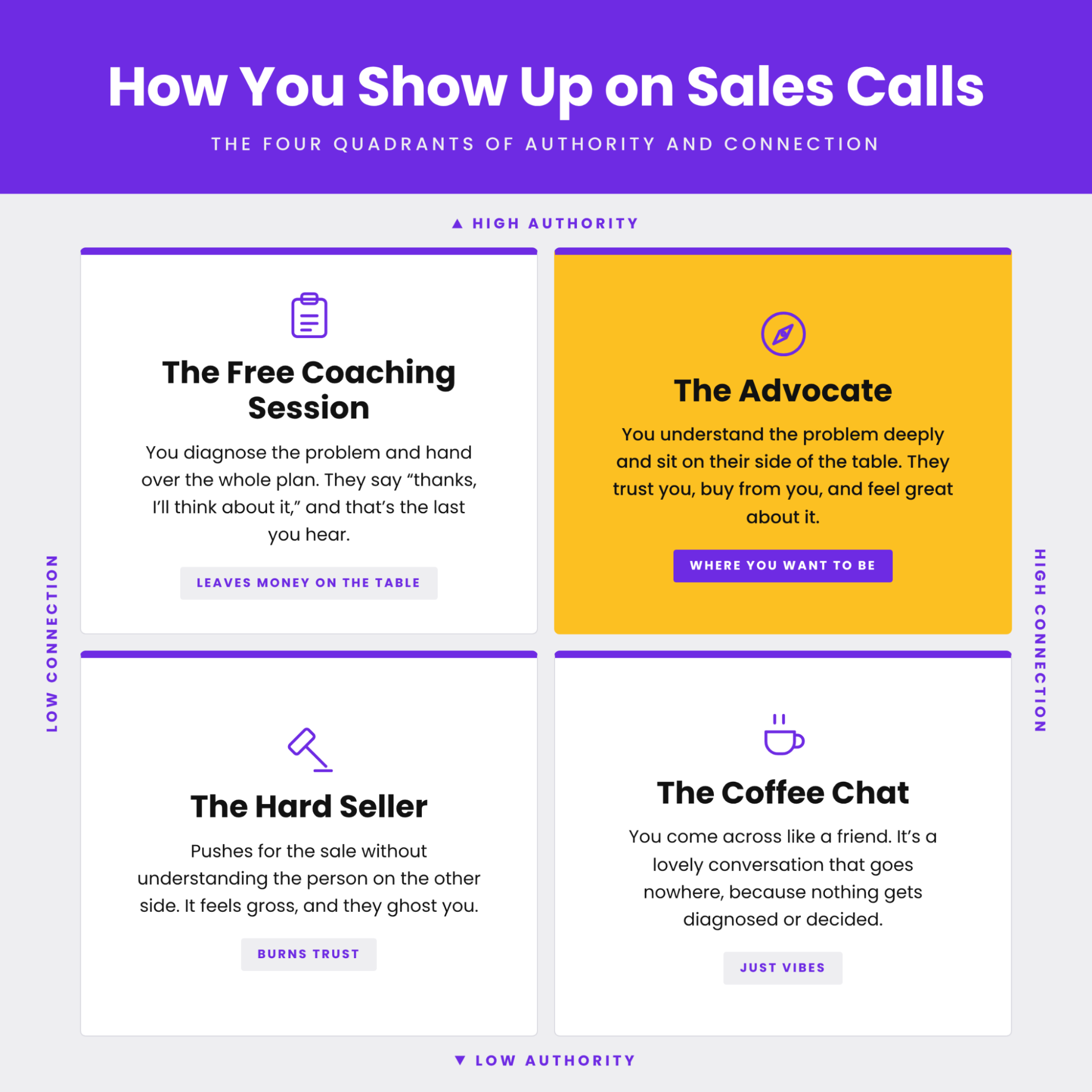
Framework: Vanessa Horn
1. The Coffee Chat
Low authority + high connection
One of my clients is a brand-new career coach. After law school, she skipped the bar exam and pivoted into tech, and she started posting about that kind of pivot.
Dozens of people messaged her on LinkedIn. Some wanted coaching. The rest asked for a “coffee chat.”
Coffee chats are common when you’re trying to break into a field, and for someone who works in that field but doesn’t coach, they’re fine. For a coach, they’re a trap. The conversation is warm, but it has no point. Nothing gets diagnosed, and there’s no way to find out how you can actually help.
Coffee chats are high connection, low authority.
It usually happens because the purpose of the call was left open-ended. The fix is to say what you do and what the call is for. That doesn’t mean they have to buy something.
I teach my clients to run “audition calls,” short calls where both people find out whether a longer conversation makes sense. Before booking, my client says:
“I’d love to understand more about your situation and put together a game plan to help you make a pivot. We can have a 15-minute call to put together some ideas. Are you up for that?”
At the start of the call, she sets the tone:
“My job today is to ask a few questions to work out if or how I can help. If I can’t, I’ll let you know and point you in the right direction. If I can, we can book another time to talk about how. Are you comfortable with that?”
By doing this, she’s asking for consent and setting the frame at the same time.
Then she asks the most important question of the call:
“Before we get started, why now? And why me?”
Why now tells you whether there’s a real, pressing problem or if they’re just curious. Why me makes more sense once you know what’s driving them.
From there, she asks questions to diagnose the situation. Before the call ends, she checks two more things:
- “Is this a later, soon, or now thing for you to solve?”
- “If we decided to work together, is there anyone else you’d need to talk to before deciding?”
That’s qualifying, and it’s part of authority too. You’re deciding who gets the next conversation, not just showing up for whoever books.
An audition call isn’t a free advice session, 15 minutes of aimless talk, or a call with no clear next step. If it’s a fit, she books the longer call. If it’s not, she points them somewhere better.
Say you’ve booked a presentation with a family friend your mom referred you to. You show up, she offers you a drink, and you spend the next hour catching up about school and her kids. It’s a great conversation. At the end she says, “This was so nice. I’ll let you know!” You brought your sample set along, but you never gave the official presentation, and you left feeling unsure about the interaction and how to follow up. That’s a coffee chat. The rapport was real, but the purpose was missing. To her, you were a nice kid stopping by. Leaving out the structure of your appointment—like sharing your “why,” walking through the products, following the script—lowered your authority and left her with zero urgency to buy. Fix it where the coach does, when you schedule the appointment: “I’d love to show you the products and see if anything makes sense for your kitchen. I’ll walk you through it, and then it’s completely up to you. A yes or a no is totally fine. Does that work?” When you arrive, of course it’s fine (and encouraged!) to connect with the customer and take an interest in their life. You can do that and keep the conversation on track by sticking to the plan and leading her through your presentation.”
What this looks like as a Vector rep
2. The Hard Seller
Low authority + low connection
This is the salesperson stereotype most people picture when they think of sales. It’s also why so many people are uncomfortable with selling—they assume you have to be this person to do it. You don’t.
The hard seller has one goal: Get the sale, whether or not the person actually needs what’s being sold.
That makes them low in authority.
A high-authority salesperson asks good questions, learns the person’s situation, and only then makes a recommendation.
A hard seller walks in with the sale already decided, so there’s nothing to diagnose. They’re also low in connection, because they aren’t trying to understand the person on the other side.
Without authority or connection, the only tool left is pressure.
Most people have been on the receiving end of an icky interaction like this.
Pressure-driven sales lead to buyer’s remorse, and that regret turns into canceled orders, returns, and customers who’d never send a friend your way.
Some things salespeople do really can help someone make a decision:
- Handling objections: understanding and addressing what they’re unsure about
- Continuing the conversation after a no: getting curious about what’s behind it, not pushing past it
- Challenging beliefs: offering another perspective
A little nudging is often needed to make the sale. But when there’s no connection built first, these techniques turn into hard closing. The test is whether you’re helping them decide or pushing them to say yes. And if the answer is still no, respect it.
Even good reps slip into this, especially when they’re nervous or chasing a goal. You’ve just finished a presentation for a friend of your family’s. She says, “It’s a lot of money.” You jump in: “But it comes with the Forever Guarantee!” She hesitates. You push: “You’d really regret not getting it.” She sighs and orders the smallest thing on the table. You leave with a sale and without trying to understand her perspective. A week later she wishes she hadn’t purchased. What could have led to other referrals instead left her feeling uneasy about how the sale happened and potentially strained the relationship. What if you had slowed down at “It’s a lot of money”? Instead of letting her hesitation rattle you, you get curious. You ask questions to learn more about her specific budget and what’s most important to her (who is cooking, how often, what would be most practical for her everyday life). “Would you be open to looking at other options that are a better fit for your budget?” If she still doesn’t want to move forward or it’s the wrong time, you thank her and leave the door open.
What this looks like as a Vector rep
3. The Free Coaching Session
High authority + low connection
My clients are coaches. They’re smart, they know how to solve their clients’ problems, and that becomes an issue when they jump into coaching mode too soon.
I often see them lose sales, and the chance to help people, because they’re high in authority but low in connection.
Most are good at discovery, meaning they ask questions about someone’s situation so they know what to recommend. For a career coach, that sounds like:
- How soon are you looking to get a job?
- How many interviews have you landed?
- How many offers have you gotten?
Discovery gets you facts, but connection helps you understand the person.
Once they have the facts, they spend the second half of the call live coaching, telling the person exactly what they’d do to get the role. You’d think that would lead to a sale, since it shows authority.
Often it doesn’t.
When you solve someone’s problem on the call, it breaks the tension. They feel relief, say thanks, and leave with a plan and no reason to buy one.
Connection means connecting with the good, the bad, and the ugly.
Someone struggling to find a job isn’t only missing a plan. They might be stuck in a job they’re just tolerating, watching friends move ahead, or wondering if their field is shrinking.
Underneath that is an emotional layer—what they believe about themselves and their situation.
A lot of coaches miss it.
It can seem like you understand their situation when you don’t understand them. The point isn’t to make anyone feel worse; it’s to show that you see what they’re dealing with.
I once listened in on a call between one of my clients and a woman who wanted to switch industries. She felt she didn’t have enough experience on paper, even though at her job she was building custom CRMs, running internal workshops, and running full-blown social media campaigns. She figured it didn’t count because she worked at a small company.
My client knew those skills transferred and was sure she could help. It didn’t matter, because she wasn’t listening to the conversation underneath the conversation (hello coded language). The woman kept saying things like:
- “I wonder if the companies I reach out to would want me.”
- “I don’t think I look capable.”
Then she mentioned what my client missed: She never had to pay for career coaching before and this was all new to her. She’d never had trouble landing a job in the past.
She shared key information about her beliefs—that her skills might not count, that she isn’t the type of person who needs help, and that hiring a coach would feel like a form of defeat—and those beliefs shaped her decision more than any advice could.
What if the coach had said: “It sounds like you’re excited, and you agree your skills could transfer. But part of you is wondering if these companies would actually pick you. And hiring a coach is new, because you’ve always just gotten the job. Does that sound right?”
That response doesn’t push. It shows her she’s been heard, and “does that sound right?” lets her correct it. Now the coach has earned the right to talk about next steps.
You’ve done everything right on the knowledge side. You can explain the Double-D edge and the Forever Guarantee, and you asked good questions about how your customer cooks. You recommend exactly what fits. She says, “This is great. Let me think about it.” Earlier, almost in passing, she’d said, “I’ve never spent this much on kitchen stuff. My mom would say my old knives are fine.” That was the sentence that mattered, and you walked right past it. Instead of repeating the features, slow down: “It sounds like you can see how these would make cooking easier, but part of you wonders if it’s okay to spend this much when the old ones still work. Is that right?” Then listen. Whatever she decides, active listening helps you both build the relationship and lead her to the best options for her.
What this looks like as a Vector rep
4. The Advocate (the consultative sales approach)
High authority + high connection
The last way to show up is the consultative approach and that’s the one to aim for. Here you come across as an advocate.
You’re building connection and rapport while also showing authority. You use some of the sales techniques typically associated with closing, like handling objections and asking about a no, but without the pressure. You’re focused on what’s best for the customer.
Alex Hormozi says the best thing you can do in sales is be the one who truly cares for your client.
He also says sales is a transfer of belief over a bridge of trust.
As the authority, you hold the belief. Once you’ve diagnosed the situation, you know whether what you offer can help them. But they have to trust you before that belief can transfer. (And if it turns out you can’t help, saying so is part of the job.)
In the connection part of the call, you’re gathering information like you would in discovery, with two extra questions: What is this problem costing them, and what happens if nothing changes? These questions help the person see their own situation clearly; they’re not meant to apply pressure.
Take the career coach example. Say a prospect tells you they feel stagnant, their employer offers no training, and they see AI as a threat. You could simply ask:
“What would it mean to you if a year from now you were still in that same job?”
Then listen. It might mean they feel behind. It might mean everything they worked for feels wasted. They might start feeling negative about their identity.
I once had a call with a health coach who wanted to make a bigger impact but was struggling with marketing and sales. I asked her:
“What has it cost you so far to not be good at sales and marketing?”
She said, “I know I need to help people. I know I’m here to make an impact, and I know I can’t make that impact if I can’t get it across in my marketing and my sales.” She got emotional.
I could have rushed to comfort her and move on.
Instead I stayed with her, because being on her side meant helping her see the situation clearly. I asked, “How much longer is that going to be okay?” She said, “It’s no longer okay.”
I wasn’t trying to push her toward a yes. I wanted to make sure she’d heard what she just told me, and then I gave her room to think. I also told her it was fine if now wasn’t the right time.
She decided to work with me.
That’s what it means to be an advocate—diagnose, connect, help the person decide, and respect the answer.
Let’s say you’re giving a presentation to a new referral. He says, “My sister has a set like this and swears by it.” You ask, “What does she use it for?” He says, “She hosts every holiday.” You ask, “Do you host?” and he says, “I’m supposed to this year, and I’m kinda stressed about it.” Now the conversation is about hosting, not knives. You ask, “What would make it feel good?” As the conversation continues, you determine the best options for his budget and the upcoming holiday celebration—the chef’s knife, a carving set, and table knives for the guests. Because you asked thoughtful questions, listened well, and wanted what made sense for your customer, you were able to make the sale. Another time might turn out differently, but because you practice a consultative sales approach and nurture the relationship, you can stay in touch and follow up.
What this looks like as a Vector rep
How to run a high-authority, high-connection call
Here’s what I tell my own clients to help them show up with high authority and high connection, and help people make a good decision.
Step 1: Set a clear agenda
By the time someone’s on the game plan call, you already know why now, how soon they want to solve it, and who’s involved in the decision. Now you frame the call so you’re actually helping. I say:
“Hey, there’s a framework for conversations that I like to use. Are you comfortable with that?”
They say yes.
“My goal is to find out three things: your goals and vision for your coaching business, where things are right now, and what’s getting in the way. That way we can put together a plan that actually fits.
In the first half, I’ll ask you questions. In the second half, we’ll walk through what a game plan would look like. At the end, I’ll invite you to work with me if that makes sense for both of us.
Ask as many questions as you want. All I ask is that we end with a clear decision, yes or no, either way.”
That sets the tone, and it gets you permission to make an offer later, so it doesn’t come as a surprise.
As a rep: “Thanks for having me. I’m selling Cutco because [share your why]. Here’s what I’d like to do: I’ll ask a few questions about how you cook and what you’re looking for, show you what I think would fit, and at the end you can tell me if you’d like to buy something today. And if not, that’s completely fine. Does that work?”
Step 2: Do discovery, and ask what it’s worth to them
Go through discovery as usual, and add two questions: what is this costing you, and what happens if nothing changes? Go back to their why now. Most people take action because something prompted them. Your job is to understand what that was and how much it matters, so both of you can see whether this is worth acting on.
As a rep: If they complain about the poor quality of their current knives, the cost might mean dull knives that make cooking more frustrating. If nothing changes, they may end up buying more low-quality knives more frequently.
Step 3: Stay in the decision with them
By the time you get to the invitation, things will still come up. They might say, “I need to think about it.”
If you hear that a lot, the call was usually lost earlier. You didn’t get a strong reason why now, you didn’t check the timing, or the person who makes the decision wasn’t there.
When it does come up, don’t rush past it. Ask: “What do you need to think about?”
Now you’re working through the decision together. If priorities come up, keep the question open: “What matters most to you in making this decision?”
Bring back what they told you earlier about what they want: “You mentioned you wanted ___. Does this get you there?” Use their goals, not their struggles.
Be warm with the person, firm on the structure, and quiet after the question so they have room to think.
As a rep: She says, “I need to think about it.” You say, “Of course. Are there specific concerns you have or questions I can answer?” If it’s “It’s just a lot,” ask, “Is it the price, the timing, or whether you’d use them?” With connection and thoughtful questions, you may end up finding something that a better fit for her and if not, depending on your conversation, you can follow up in a few weeks or months.
Step 4: Have the honest conversation
Sometimes helping someone decide means having an uncomfortable or challenging conversation. People do have limiting beliefs, and that’s where objection handling usually happens on a call.
But you’re not trying to convince them. You’re giving them a structured space to think out loud and look at their situation clearly, so they can act on something they already want to do.
In my work, people usually come to the call wanting the outcome, so when they hesitate, it’s often one of three things:
- They don’t trust themselves
- They don’t trust me
- They don’t trust the process
Bring those into the open. Ask questions, listen to the answers, and stay curious until you’ve covered their concerns.
Sometimes it’s not the right product, price, or time, and that’s ok, too.
The consultative sales approach mindset
Let’s go back to the doctor. Her job isn’t to tell you what you want to hear, and it isn’t to decide for you. She determines your diagnosis, lays out your options and gives recommendations, and hands over the choice to you. If you say you need time, she gives it to you.
Expertise earns you a seat at the table, and connection earns you the right to speak once you’re there.
So during your next call or presentation, don’t try to win. Try to be useful. Be transparent about the conversation you want to have. Go beneath the surface. Say the thing that needs saying, and then give them room to decide.
Some of those conversations will end in a sale, and some won’t. Either way, the person on the other side will walk away feeling heard.
And that’s the salesperson people come back to.
.
.
Ready to sharpen your sales skills and practice the consultative sales approach with real customers? Request an interview.